Showing posts with label computers. Show all posts

Tuesday, June 7, 2011

World IPv6 day tomorrow

The (nearly) 256^4 = 4+ billion IPv4 addresses identifying the computers on the Internet are gone and this system of identification has therefore entered the cap-and-trade system. ;-)

Microsoft has already bought some allowances. One IP address is about 11 dollars, much like a ton of CO2 emission rights. ;-)

Many ad hoc tricks exist to circumvent the capacity limitation but a new global system that will simply eliminate the need for tricks may eventually become preferred. The IPv6 system - designed to distinguish 2^128 hosts - not far from 10^123 bits that can be stored in the visible patch of our (nearly) de Sitter space - is the leading candidate. Operating systems and, to a lesser extent, routers have been trained to be compatible with it for a decade.

However, only a few percent of the Internet traffic is running through IPv6 at this moment - it is mostly peer-to-peer exchange of the data and most of it is arguably violating someone's copyrights. Turning IPv4 off would almost surely mean an unbelievable hassle at this moment. Fortunately, it's not needed.

On Wednesday, the world will celebrate the IPv6 day and you will be allowed to find out how huge a debacle it would be for you if the IPv4 addresses were suddenly turned off.


Don't be afraid. IPv4 won't be turned off tomorrow. But various providers and Internet companies will try to be available via IPv6. You may try ipv6.google.com. If you can open it, you're just doing great. I can't. ;-) Internet Explorer tends to use some bridge or whatever it is, teredo, but I think it's not too useful.

You may only have problems tomorrow if your computer decides that IPv6 is cool and working and decides to switch to it - while another part of the network is not ready. In the case you will have problems with your connection, find your connection settings in a control panel and turn IPv6 off.

Are there some regions that are getting ready for IPv6? Well, there is one. CZ.NIC has just announced that *.cz is the most technologically advanced top-level domain of the Internet when it comes to the percentage of the content that is already available via IPv6: it's eight percent! The percentage has quintupled during the last year - it's almost like the solar panels! :-)

To compare, *.de, *.com, and *.net domains only have one percent of the content available via IPv6 these days. You may try to test your connection at test-ipv6.com, get a more optimistic message at ipv6test.google.com (my connection passes even without an IPv6 address) or read some other tips from Google and 10 tricks from PC World that are related to the IPv6 day.

Sunday, June 5, 2011

Rebooting the cosmos?

When I was at faculty of Harvard, Ed Fredkin was among the fun and famous people who came to me and wanted to chat on a periodic basis. He told me that Richard Feynman had died some time ago but Feynman used to provide him with some vital feedback concerning Fredkin's ambitious digital theories about the Universe. So Fredkin found it natural that I would replace Feynman's functions.

I enjoyed the meeting with him but I couldn't afford to be distracted on a periodic basis.

Moreover, I've been really overwhelmed by such things since the middle of my undergraduate studies. As a freshman, I could have been open to a curious debate about "discrete vs continuous" but I quickly found out that the "discrete champions" simply get stuck with totally elementary things and simple errors. They were apparently denying empirically extracted principles that I consider essential in the structure of our knowledge about physics - and they may have been denying all empirical data, after all - and further discussions were just dragging me to the bottom of the sea.

It has always looked to me that I was nearly the only person on the planet who hadn't lost his mind concerning these matters. These patently wrong opinions - e.g. that the world has to be fundamentally digital - seem to be everywhere even today; people's time spent with the computers is arguably making this thing even worse. I am sure that most of the best physicists don't think it's right - just like the top physicists of the previous generations - but the top physicists today rarely talk to anyone outside the ivory towers so you don't really know. Even I am not really sure whether they have ever thought about these issues and what they have found.
Update: However, I just learned about the excellent essay by David Tong for the FQXI "discrete vs continuous" essay contest where he earned a silver prize even though the golden essay is kind of silly. He explains how all integers in Nature are derived, "emergent", and ultimately approximate and/or ill-defined. I would endorse every letter of his essay.

He starts with a silly quote by Kronecker - on "God who made the integers; everything else is an invention of Man" - that's been debunked by nearly all subsequent developments in maths. Tong shows that the integers are derived from more fundamental equations, if they exist (e.g. "n" in the Hydrogen atom's energy shows that "God only made the complex numbers and everything else follows from Schrödinger's equation"), and ill-defined in many other contexts (number of planets, particles, particle species, and even dimensions), and ends up with chiral fermions (that can't be put on lattice) as another way to prove that we don't live in a Matrix. ;-)

A priori, Tong says, the universe could have been discrete. However, remarkably, a posteriori, we were allowed to accumulate a large number of proofs that it is not.
Oh yeah, I have to include a picture of Steven Spielberg to clarify why a waitress wanted Fredkin's autograph. ;-)

So the result is that the pop-science has totally taken over the broader perception of physics. And the paradigm that the Universe is fundamentally digital is one of those holy and popular albeit flagrantly wrong concepts. I would have enjoyed talking with Fredkin on a periodic basis but only if I hadn't been exposed to thousands of deluded people who were not willing or capable to understand very simple arguments.

Moreover, I was kind of sure that Fredkin had to have heard all the disproofs he would hear from me from Feynman - every sane physicist has to converge to similar ideas about these matters and be able to produce counterexamples to any of the proposed discrete theories because they're really dictated by the knowledge about the discipline - so I couldn't have contributed anything truly "novel", I was afraid, because only positive things are viewed as "novel" by the discrete physicists. The digital Universe has become a religion. An insane one.

Phil Gibbs just posted a link to the videos of the World Science Festival in New York and one of them is called "Rebooting the Cosmos: Is the Universe the Ultimate Computer?". Here is the video:


Watch live streaming video from worldsciencefestival at livestream.com

The 96-minute video above features Ed Fredkin, Seth Lloyd, Fotini Markopoulou, and others. I swear that the video worked yesterday but the sponsors had to run out of money and it offers the audio only today. But whenever you click at "pause", it shows you the current screenshot haha.

I just completed the translation of the relevant chapter of Brian Greene's book, The Hidden Reality. Nine types of multiverses are nicely discussed in the book, although many things - especially about the interpretation of quantum mechanics - are just plain wrong. And of course, Ed Fredkin is discussed in the context of the simulated (and partly definitive) multiverses.


Just to be sure about Brian Greene's terminology, the simulated multiverse is the set of all universe-like simulations that run on computers and simulated computers within computers, and so on. The definitive multiverse is the set of all theories and mathematical structures with all the data, pretty much equivalent to the meta-structure of Max Tegmark.

From the reading of the book, it's clear that Brian Greene is a digital convert, too. So are all the participants of the "rebooted" discussion above. Now, that's crazy. Is that really impossible for the organizers to also invite someone who actually knows how these things work in the real world and someone who could show that all these visions, however attractive for many people, are just plain wrong?

First, it's clear that the Universe isn't a classical digital computer because of quantum mechanics. To reproduce experimentally verified high correlations and other features implied by quantum mechanics in a classical language, you would need some awkward non-local theory that would violate the Lorentz invariance at the fundamental level.

But the Lorentz symmetry may be shown to hold - in fact, up to the accuracy of 10^{-11} at the Planck scale - using birefringence and gamma-ray bursts. You would have to believe that all the tests of special relativity and Lorentz invariance are just giant conspiracies. It's not just one fine-tuning you need to avoid contradictions with the observations: there are dozens of currently doable measurements of effects (and terms in the effective Lagrangian) where the Lorentz violations could show up but they don't. The maximum speeds allowed for every particle species we know and every bound state is the speed of light. For each species, you would need one huge fine-tuning to explain why Einstein's 1905 theory works.

It's clearly insane and, as implied by Bell's inequality, GHZM experiments, Hardy's "paradox", and many other setups, this insanity would become even worse if you tried to add quantum mechanics to your computer-like description of the Universe.

Our Universe cannot be a digital computer. This is not a constantly open, unreachable, philosophical mystery. It's a part of the things that science has become able to address more than a century ago and the answer is No, it cannot work, at a confidence level that is much more certain than many other things we usually present as "certain". Our Universe can't even be a discrete quantum computer. The Lorentz symmetry is among several continuous symmetries that simply could never naturally "emerge" out of a fundamentally discrete starting point, even if it were were a quantum discrete description.

But even if I forget about the body of the empirical evidence that makes it clear that a digital computer - especially a classical digital computer - can't be a description of the world around us, I would have even "philosophical" problems with the idea that the digital viewpoint "should" be more fundamental.

Even if I forget about the experiments and the quantum and relativistic structures that followed from it, I just find it obvious that pretty much by definition, discrete objects are always less fundamental and less complete than the continuous ones. A discrete description of some object or phenomenon is always an approximation. It's what bureaucrats do with the people - they represent them by a few numbers. You use it if you only have a limited number of bytes to discuss something; if you want to draw "caricatures" of the reality; if you want to approximate complex things by oversimplified models. Atoms or people as dots or triangles.

But discrete fundamental objects couldn't have well-defined interactions that are constrained by physical principles. There's a kind of a duality or trade-off that if your objects are too discrete, there are too many rules that you may create for them - a multi-dimensional continuum of their possible interactions, so to say. The non-renormalizability of loop quantum gravity is an example - you may add infinitely many types of interactions to the spin network and the resulting theory will still belong to the same class of hopeless mess. It may sound paradoxical but only if you study continuous objects and continuous conditions that constrain them, you may reduce the number of solutions to a discrete number of possibilities. That's how you may derive the whole spectrum of atoms from a single equation; it only works because the equation works with continuous objects. If the fundamental objects are discrete, the number of different theories is continuously infinite. If the objects are continuous, you have a chance that the consistency conditions will actually tell you something.

The old Bohr model of that atom was too discrete a description of the hydrogen atom; the electron was just a point mass and the orbits were bureaucratically constrained in an ad hoc way. Clearly, they could have been constrained in other ways: this discrete model was just adjusted to agree with a pattern of the hydrogen spectrum. It had some OK features but it was obviously naive. A better theory, quantum mechanics, used a continuous wave in 3+1 dimensions. The same theory applied to many bodies has to use wave functions in many more dimensions. In some sense, they're more continuous than the 3+1-dimensional waves. Quantum field theory uses an even more continuous description - the wave functional depends on infinitely many degrees of freedom. In some sense, string theory goes even one step further but it can regulate the exploding complications.

In many situations, the Hilbert space may be produced by a discrete basis, and so on. But the precise energies etc. of an energy eigenstate basis have the values they have only because there is a fundamental continous explanation. If the discrete description were the last word, the energies of all the states and the interactions of objects could be changed in infinitely many ways.

So there will always be an interplay between discrete and continuous objects in physics. But it's always the case that when your description looks fundamentally discrete at some level, it's because you haven't understood it well enough yet. The same message works in pure mathematics, too. There are interplays between number theory and complex functions. But the complex functions - such as the Riemann zeta function - are the "more fundamental" perspective on these common problems. It becomes even more obvious if some of the continuous parameters - the physics' counterparts of the zeros of the Riemann zeta function - can actually be measured.

Thursday, June 2, 2011

Windows 8 PCs will be like iPad 2.8

Microsoft is catching up.


The video looks pretty impressive and the inspiration from iOS in particular is hard to hide.


Available in late 2012.

Friday, May 13, 2011

Precalculus and chemistry solved: WolframAlpha iOS apps

In January, I wrote about WolframAlpha iPhone apps for algebra, calculus, and music. There also exist astronomy and multivariable calculus apps.

Your humble correspondent could finally test two new "course assistant" apps described at the WolframAlpha blog. They help users to master and solve:
Both course assistants are cute. The user interface is clean and comprehensible and the results are relevant.

There are also lots of details that make the experience more pleasant and the usage more effective. One of them is good for testers such as myself: whenever you're using a tool in the app and you have to enter something, there are always pre-filled input parameters that produce an interesting enough output. You may modify them or discard them but you're never lost by having a tool with no idea how to get an interesting answer from it.

For another example, when you're supposed to enter an element, more general chemical formula, or a mathematical expression for a function, you always get a new relevant keyboard. This is just an example of the screen when you're trying to get the electron configuration of silicon.


You can imagine how many hours one could have save at school - and not only at school - if he had (and was allowed to use) these apps. I am convinced that if you are a student who hasn't memorized all of precalculus and general chemistry or if you use these things in your job or if you know a kid or someone else who needs to solve similar tasks, you should buy the $4.99 apps.


Let us look at the precalculus app. The first thing you will find is a menu with 8 categories; combinatorics didn't made it to the picture below.


...

Some of them have submenus. You enter your problem. Depending on the context, you write the expressions with a certain kind of a keyboard. And of course, the application solves your problem in an appropriate way.


In this case, you obtained a plot. Of course, in many other cases the result is more "talkative". When you're solving a trigonometric equation, it may have many solutions.


...

Sometime in the past, I would be tutoring all these things - how to draw vectors, compute their sums, dot products, other products, how to draw functions, solve sets of linear equations, and so on. This app would have surely been useful for "my" student who hadn't really learned those things and gave up. ;-)

In March, in the article called Michael Green: Math Classes Are Boring, I have been thinking about whether or not the math classes should be made easier and whether the hard work should be eliminated. My answer was essentially No.

These apps show that there are lots of mechanical things that students are required to do and that may be fully replaced by software - such as the apps based on WolframAlpha. (Yes, the apps need to connect to the Internet.) However, I would much happier if the buyers were not using the app just to cheat - whenever the teacher allows it. They should play with it and see what happens. They should learn.

An app may make learning more efficient but I don't think that it should replace it. When you don't spend enough time by doing hard mechanical work, you won't understand what's happening inside similar apps. Consequently, you will be unable to even formulate the right questions.

If someone uses the Precalculus App to cheat, he will experience some fun things. In most cases, the solution is given with the full treatment that a high school or elementary school teacher may expect. But sometimes it just spits the right result. If a student copies it, it may be suspicious how he got it.

The suspicions may turn into a self-evident fact once an otherwise problematic basic school student copies some trigonometric results that involve exp(ix) or combinatorial results that include the Gamma function - and be sure that the app naturally returns them (at least as one of the ways to express the result) in several cases because the underlying Mathematica is assuming functions of complex variables at the end.

The general chemistry app is divided into 9 main categories; the 3 that didn't get to the picture below are acids & bases; the nucleus; units & chemical properties. Many of them have subcategories and even subsubcategories but the hierarchy is natural.


...

The problems it can solve deal with as simple things as unit conversions, counting of protons in elements, simple inorganic compounds as well as many complicated things such as finding the equilibrium concentrations in chemical reactions etc. Even some of the simple graphs and tables you get are revealing.


For example, I would be sure that the (first) ionization energy of elements - alkali metals have been marked as red by the user (and they have a very low ionization energy) - has to look like this but I don't think that this graph has been shown to us in chemistry classes. Of course, you will find lots of others.


...

In the example above, the user enters a particular compound and some information that determines how much of it you have in a solution and the app describes the properties of the solutions in many other ways.

The examples above are somewhat obscure but there's a lot of the typical calculations, table data, conversions, lists of elements and acids and other things that belong to various groups - whatever you would expect from a good "intelligent textbook".

Recommended.

Movie: Antonio Banderas looks for the Higgs boson

"The Big Bang", a 2011 movie, is coming to the U.S. movie theaters today.


See Wikipedia, review in The New York Times, IMDB, and Google News.


Spoiler alert: don't read the text below

The plot makes a lot of sense. Antonio Banderas is a private detective who is hired by a Russian boxer and criminal to find his missing girlfriend, a stripper called Lexie who is also carbon-enhanced by $30 million in diamonds. He chooses the most sensible strategy to solve this puzzle: he must first find the Higgs boson.

The film directors have also understood what billions of viewers in the world are actually aroused by. During some boring and unexciting portions of the film, e.g. sex, the characters are made to discuss physics of neutrons which makes it much more thrilling.

Fine. So how does he find the Higgs boson? He must locate the most sensible place where the God particle may be produced by high-energy collisions. Where is the place? Obviously, it's in the basement owned by a billionaire who has built a private superconducting collider under his villa in the New Mexico desert. He employs a physicist who knows all about particle physics and spiritism.

See the key scene at IO9 where Banderas visits the haunted house with the superconducting supercollider and they just sketch the ideal channels where the cross section for the Higgs boson production could be high enough while they estimate the lifetime of the scalar particle. By the way, a nice by-product of the calculation is that the rich guy also plans to recreate the Big Bang and end the world as we know it. :-)

One thing to appreciate about the $17 million noir flick is the degree of realism. Finally, a movie has faithfully described the world of real private detectives whose actual methodology is based on the search for the mechanisms of the electroweak symmetry breaking. Based on the generally low rating, it seems that the critics have also understood that it's about particle physics.


Chemistry and Precalculus: new Wolfram Alpha iOS apps

See Wolfram Alpha blog to see what these two apps may do for your or your kids' courses at school. They're pretty clever apps.

Spice videos in Osama's collection

A large collection of modern porn videos was found in Osama bin Laden's villa.

Technical problems

Blogger.com has performed a maintenance on Wednesday 5/11, 10:00-10:40 pm PDF, see status.blogger.com. However, they made a mistake; I experienced intermitent problems with logging in as well partial or complete disappearance of the "profile" widget. Consequently, blogger.com went to a read-only mode. Bloggers such as your humble correspondent couldn't add new posts or edit the old ones. In the process of fixing the bug, Blogger.com engineers decided to use a "system restore" which means that they - temporarily - erased all posts added after 3:37 pm Prague Summers Time on Wednesday.

That affected 3 new posts on this blog. You may see the compassion - even Google's own official blogs such as Google Chrome Releases have been affected. In this particular case, a new blog entry about the latest stable Chrome version, 11.0.696.68, disappeared as well. Slow comments have been inaccessible across the blogspot.com domain, too.

Blogger.com had the lowest downtime among the major blogging platforms in 2010. I am afraid that after this huge downtime, it will no longer be the case. Still, this form of downtime was pretty user-friendly - a vast majority of the blog posts remained accessible. However, to make things worse for the company, Google's YouTube began to generate somewhat frequent "500 internal server errors" again. What are you up to, Mark Zuckerberg? ;-)

Ice-hockey

Sweden were the stronger team during the semifinals and they became the first team in the world that managed to beat Czechia, so they will play the final match.

Thursday, May 5, 2011

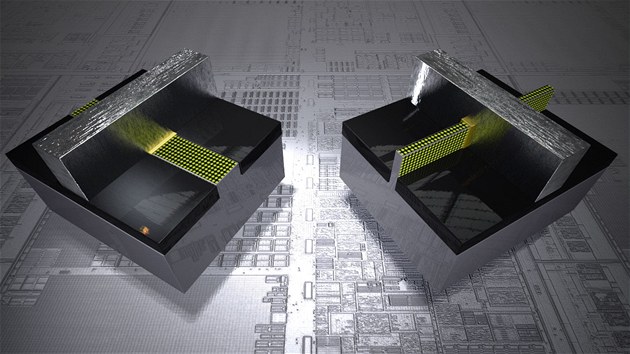
Intel: tri-gate 3D transistors within a year

Intel Sandy Bridge microprocessors are already being sold. However, Intel just announced something much more shocking, namely Ivy Bridge microprocessors that will use 3-dimensional tri-gate transistors (Google News).


The 2-dimensional transistor is illustrated on the left picture, the 3-dimensional one is on the right.


Intel's main competitor, AMD, has responded in a somewhat tragicomic fashion. They essentially said that no one will need to buy an excessively new technology that will increase performance by 37% and reduce power consumption by 50% (which may naturally double battery life, and so on) because everyone has the freedom to buy obsolete technology that sucks. ;-)

Intel will gradually switch from the 22 nm technology to the 14 nm technology by the end of 2012, I guess. I am not sure whether the percentage figures above refer to the improvement including the jump to 14 nm or not.

Wednesday, May 4, 2011

NeoPlanet

Apologies, this is just a toy for people who like to play.


ONLINE COUNTER


;

VISITOR COUNTER


No science may be found in this blog entry. You may rotate the globe above. The "people" and "planet" icons show you the cities and countries, respectively. At least I guess. The yellow points are recent visitors. The red circles are curious towns or excited or angry visitors, or something else. ;-)


Stalkers and CIA agents may bookmark this page to simplify their lives.


I suppose that NeoPod above is supposed to be an imitation of iPod Touch. ;-)

Sunday, May 1, 2011

NeoCube

This is just another toy by NeoWorx.


NeoCube is the most awkward and inconvenient way to organize the truth about recent visitors on 6 places. The places are faces of a cube. ;-)


Thursday, April 28, 2011

Al Gore, religion, Our Choice, and iPad

Larry Bell of Forbes wrote a nice article:
Climate Change As Religion: The Gospel According To Gore
He kindly credits Michael Crichton for some of the first crisp and complete explanations why the global warming orthodoxy has become a religion of the urban folks.

However, if it is a religion, it should have a Bible, right? And what is the coolest medium to create the Holy Scripture of a new 21st century religion? Well, take an iPod Touch and - pkh-vřsr-prd - make it bigger.

Al Gore's Our Choice from Push Pop Press on Vimeo.


So the right idea is to create the coolest, hugely interactive iPad book app ever written (one based on his climatic religious book, Our Choice), with an hour of films embedded in it, among other things, and sell this piece of climatic religion just for $4.99.


It seems impressive - and Gene, don't be afraid to buy a copy for your iPad and tell us what you have experienced. ;-) Unless Osama bin Laden creates his own iPad app, Al Gore will ultimately become the most influential bigot and global warming alarmist in the Middle East, too. :-)

Well, it actually seems that the app works both for iPad and iPhone (click to download). I will wait when the app is given for free; the paper version of his trash book already costs $0.88 at amazon.com, down from the original $13.77.

As an updated Buddhist proverb says, modern information technology offers humans a key to the heavens; the same key opens the gates of the hell, too. It is somewhat scary that because of the accumulation of gray green capital, one of the most deluded and atrocious aš$holes in the world who should be jailed for the rest of his life was able to pay for the creation of one of the most technically impressive iPad app that he will undoubtedly use to brainwash thousands of people.

Just to show you the stunning new benchmark for e-books that the rotten apples who have joined al-Gore (former Apple engineers) developed, see this introduction how to browse the e-book:

Al Gore's Our Choice Guided Tour from Push Pop Press on Vimeo.

Wednesday, March 30, 2011

A library in Prague: 40 gigapixels

In May 2009, I declared a contest based on a 1.5 gigapixel photograph of the Obama inauguration. In December 2009, TRF mentioned the world's largest spherical panoramic photograph: its 18 gigapixels were collected on the Prague TV tower.


Click the 0.00012 gigapixel picture to zoom in and to obtain a 0.0013 gigapixel image.

The progress hasn't stopped. The world's largest indoor photograph has 40 gigapixels and you may guess the the city where it was taken: well, it's Prague once again. As the WSJ blogs and others figured out, it's a photograph of the Library of the Strahov Monastery (early 18th century) by Jeffrey Martin.


Here it is:
Strahov Library's 40 gigapixels (Flash needed)
You may try the "tour". Let me try to avoid the misunderstanding once again: your digital camera probably has megapixels only and we're talking about gigapixels here which is not quite the same thing. ;-)

Wednesday, March 2, 2011

iPad 2: even larger?

Serious update: See live coverage of the iPad 2 event.

In 2010, Apple took an iPod Touch and - bchřšžprd - made it bigger. This iPad became an important companion of Gene's - and of others. Tomorrow, Apple is likely to release iPad 2.

They took an iPad - bchřšžprd - and made it bigger. :-)


As you can see, it has become very convenient.

They will also give you about 30 square meters of sensitive glass so that you may improve your apartment and your street.


The glassy system has been tried in a family of beta testers - an ordinary working family in Libya:


That was before the civil war - that became the topic of the 4883rd episode of the Star Wars:


More seriously, this is how the shape of iPad 2 could look like:


And iPhone 5 is likely to have an edge-to-edge display:

Wednesday, February 16, 2011

CERN chooses Hewlett-Packard for networking


According to Business Wire,
HP Boosts Performance of CERN Network
Products and services of Hewlett-Packard were chosen by the CERN network team to deal, among other things, with the 15 million gigabytes of data that the LHC needs to share, store, and analyze every year.


That's more data than what could be stored on the whole hard disk of my ancient HP Pavilion ze4125 laptop ;-) which I still keep alive but no longer use too often.

It seems that the network will primarily use the new IPv6 protocol for IP addresses.

Monday, February 14, 2011

How does an average French woman look like?

A topic for Valentine's Day.

Did you ever want to know how the/an average German woman or the/an average black American woman looks like? Those questions have already been calculated by Face Research. Here is a couple of nations:


Here are the averages for 46 nations. You may also create your own averages, including those involving your photograph.


The average women are pretty attractive. I think it's not hard to understand why. People are instinctively trained to dislike visual features that strongly deviate from the average and the average women have none of them. Moreover, the averaging is likely to remove all local non-uniform perturbations that are also considered "ugly".

Tuesday, February 1, 2011

IPv4 addresses are gone: cap and trade

The transition to IPv6 will produce glitches: no need to hurry

The IPv4 addresses began to be distributed approximately 40 years ago. Today, they're essentially gone.

This incumbent arrangement to identify the computers on the network by a sequence of 4 bytes (usually written as four.integers.below.256) may distinguish about 256^4=16^8=2^32 i.e. over 4 billion hosts which would be considered a large number of computers in the 1970s. Well, it's not too large today: in fact, it's smaller than the world population.

As recently as yesterday, the global Internet had 7/256 (fraction) of the IP addresses available. However, as expected, the Asian distributor of the IP addresses received 2/256 (fraction) of addresses from the global distributor today. This means that only 5/256 (fraction) of addresses were remaining. And there's a rule that once this happens, each continental supervisor receives one of the five remaining ones. In other words, the IP addresses have been depleted at the continental level.


For a few months, the continental distributors will be capable to spread the remaining IP addresses they have been assigned: there are not too many. On 8th of June, 2011, the leading Internet companies will celebrate the World IPv6 Day during which they will try to launch all services in IPv6 and encourage the users to access the Internet via IPv6.

Today, the percentage of traffic using the new IPv6 format is about 1 percent.

The depletion of the IP addresses is no disaster, of course. The Internet won't collapse. The limitations may be circumvented by many tricks. However, the Internet cannot grow in the simple old way. Instead of forcing the companies to use dozens of assorted tricks to circumvent the limitations on the number of available IP addresses, it seems easier to ultimately switch to a new system that gives us much more room for breathing.

The IPv6 addresses are viewed as the canonical replacement of IPv4. Instead of 2^32 hosts, they may distinguish 2^128 hosts = 3 x 10^{38} gadgets. That's approximately equal to the mass of the Solar System in micrograms, so if you convert the Sun - and the rest of the Solar System - to devices connected to the Internet and each of them will weigh at least one microgram, you will have enough IP addresses. ;-)

So if you use an IP address to identify each baguette you buy in the supermarket, the seller must be careful to recycle most of the IP addresses once the baguette is eaten - otherwise we could run out of the IPv6 addresses, too. If a new IPv6 address were used for every "event", 10^{38} would still be enough to cover the life of the civilization until the death of the Sun but it would not be too many, especially because IPv6 is built with the expectation that by generous clustering, the system may waste a vast majority of the available numbers.

Physics intermezzo

The large number 2^128 of IP addresses has already been attacked by the World Union of Kooks and Crackpots. Mr John Horgan said that such a large number was "ironic science" because you may never falsify the statement that another person has an IPv6 address: to do so, you would have to try 2^128 IP addresses one by one (at least Mr Horgan isn't capable to think of another strategy) which is impossible.

Mr John Horgan and Mr Lee Smolin have criticized the landscape of IP possibilities because it undermines the moral values. Having a large number of IP addresses is as immoral as as speculation in subprime mortgages, as Mr John Horgan figured out. You may always kill someone if you have an IPv6 address because there exists another copy of you with a different IPv6 address who hasn't killed anyone.

These criticisms by Mr John Horgan and Mr Lee Smolin, directed against the new book by Brian Greene, were not joined by their colleague in vitriol, Mr Peter Woit, because the latter is employed as a dirt eater by compassionate Brian Greene himself.

But back to the IPv4/6 addresses

The addresses will get exhausted in a few months and the pressure to open the new living space will be increasing. Most of the key Internet companies will be ready. However, many other companies and regular users may be partly screwed because they may need new routers to deal with IPv6 etc. The transition to IPv6 won't necessarily be problem-free. In fact, I am confident that the number of problems will be vastly higher than what we saw during the overhyped "Y2K problems" in the year 2000.

So several World IPv6 days may be needed to see that a vast majority of the Internet - and especially the key services - will be able to deal with IPv6.

I guess that it will be impossible to turn IPv4 off as early as in 2011, for example. The IPv6 Internet will exist simultaneously with the old one for some time. New IPv6 users without IPv4 won't be able to access services that only have the old IPv4 and vice versa (the opposite case is unlikely because there is no reason for important services to suddenly abandon the support for IPv4).

Thursday, January 20, 2011

Intel Sandy Bridge is here

In recent years, I was disappointed by the rate at which the speed of microprocessors was increasing. While Moore's law describing the total number of transistors worked very well - the number of transistors in a computer is doubling every two years - and the memory (and flash disk) capacity was increasingly nicely as well, the frequencies of the microprocessors in computers you could buy were not changing much. Of course, I realize that there was a transition to multi-core processors, but anyway, it looked slow.

Finally, Intel began to sell its Sandy Bridge processors and they became a part of many computers that are sold across the world, including my homeland. They use the 32 nanometer architecture: finally some progress.

In 1971, computers would be built on a 10-micron architecture. Every five years or so, the distance scale dropped by a factor of two or so. When I was leaving America in 2007, they would be getting ready for the 45 nanometer architecture which was launched in 2008. Finally, we have another step.

The computers with the 32-nm chips consume less power - 17-55 W for laptops and 35-95 W for desktops. And of course, the speed may get a bit better, too. The jump to 22, 16, and 11 nanometers is planned for this year, 2013, and 2015, respectively. There could be a few more steps after that but it is not guaranteed: they are getting damn close to the size of the atom.


I am generally against subsidies but this is one of the contexts in which I could imagine some room for subsidies. I think that lots of slower and less efficient microprocessors will be produced in the future, making the consumers less satisfied than what would be possible and forcing them to pay more electricity than needed.

It seems to me that lots of the slowdown is due to the patents and copyrights which lead the fast companies to continue with their slower products and which prevent the slower companies from following the footsteps of their faster competitors.

Of course, the patents are very important for keeping research profitable. On the other hand, I can imagine that under some controllable and logical rules, the governments could buy these patents and release them to the public domain, at least in individual countries such as the U.S.

The justification would be that if a newer product X2 saves time and electricity that is worth P relatively to an older product X1, the government may afford to pay P for the upgrade from X1 to X2. I am sure that my fellow free-marketeers are going to burn me with anger :-) but still, I am curious what people think about these matters.

Saturday, January 15, 2011

Physics Stack Exchange

The server
Physics.StackExchange.COM (click)
allows you to ask questions about physics - and someone will answer them. Or you may answer questions asked by others. In recent days, I spent many hours with this server by the latter activity.

Physics profile for Luboš Motl at Physics, Q&A for active researchers, academics and students of physics

A similar server exists for maths, too. And probably other disciplines you may mention in the comments.

Via Cosmic Variance


Wednesday, January 12, 2011

Wolfram Alpha: apps for algebra, calculus, music

If you're a student who needs to improve your grades and you may afford to spend $1.99 or $2.99, you may like three apps for iPhone/iPod Touch that Wolfram Alpha released today:


......
Click the little screenshots to get to the iTunes homepages of the applications.


That was the algebra. Here is the calculus app:


......
And the music app:


Tuesday, January 11, 2011

Global warming panic explained

One of those computer-narrated, animated dialogues. But this one is really funny and realistic:


My favorite line was "That was in the old times. Now progress is achieved by scientists falling in line and keeping their doubts to themselves." :-)

The same user has created similar excellent videos on raising of the taxes, affirmative action, feminism, and others.

Thanks to Marc Morano


Friday, December 17, 2010

Reading level of science blogs

Search engines were not created equal. Google became a dominant brand, largely because of its ability to find the most relevant pages for given keywords.


One of the abilities of this search engine is to see that science blogs were not created equal, either; Google can divide the websites according to the reading level. I have no idea whether this rating is done automatically or whether it is based on some human input.

As Jorge Pullin has recommended me, go to google.com and type something like
site:climateaudit.org
to the search box. Right beneath the "Search" button, you may find "Advanced Search". Click at it and you will get to this page. In my case, I had to replace "hl=cs" by "hl=en" in the URL because the Czech advanced search options don't include the reading level.

Under "Need more tools?", select "Annotate..." in the "Reading level". Then click at the "Advanced Search" button at the very bottom. This will tell you the percentage of "basic", "intermediate", and "advanced" paragraphs on the website. Take 30+1 of the science blogs you know and compute the average score.

"Basic" is counted as 1 star, "intermediate" is counted as 3 stars, "advanced" is counted as 5 stars. Compute the average. What will you get?


Well, here are some results. For your convenience, I added God and idealized bullshit.


I hope that you can recognize some of the acronyms.

Of course, God's website was added above TRF in order to emphasize that I am a humble correspondent. ;-)

On the opposite end, CapitalistImperialistPig of New Mexico, William Connolley of Stoat, Clifford Johnson of Asymptotia (sorry! Google thinks that cooking is not advanced), Phil Plait of Bad Astronomy, and especially P.Z. Myers of Pharyngula reside at the very bottom, right above the idealized bullshit that was added for a similar reason as God. Congratulations, P.Z. Myers: in a completely fair world, the last two contestants would be reversed or at least tied. :-)

More seriously, you may use the table to find other blogs you may like. After TRF, you see the arXiv blog, Tommaso Dorigo's new blog, and Chris Colose's alarmist blog which is largely defunct now.

Thursday, December 16, 2010

Mobile version of The Reference Frame

The mobile version of TRF at onbile.com/lumidek has become largely obsolete today.

In fact, at some moment in the past, a program told me that onbile.com was insecure so I removed the redirecting scripts from the TRF template (although it may have been a false alarm).


Google now offers a simplified and much faster mobile version of all the blogspot.com blogs. They look like this:
motls.blogspot.com/?m=1 (click)
Note that the "m=1" parameter is added automatically if you use a mobile device but you may also add it by hand. (In URLs that already contain a question mark, "?m=1" should be replaced by "&m=1".) If you change the URL to "m=0", you will restore the large version of the blog that is used for immobile devices.


If you happen to see the minimalistic mobile version and you want to return to the big version - for example, because the minimal mobile version doesn't contain links to the fast comments - you may also click at "View web version" at the bottom of the page, right above the "Who is Lumo" section.

The mobile blog looks tidy on iOS and HTC devices, among others.


This is how blogspot.com bloggers learned about the new feature today.

If you use an iDevice, I recommend you to bookmark TRF and place an icon somewhere at your desktop. To do so, open iOS Safari, go to the main page of this blog, double-click and zoom in on a part of the screen that you would like to use as an icon, and click "+" at the bottom, and add the bookmark on the iOS desktop.

If you're a mobile visitor - about 3% of them people use some mobile devices at this moment (the percentage may be expected to rise in the future) - you may also share your experience and good ideas about ways to improve the experience.