Showing posts with label LHC. Show all posts

Friday, June 10, 2011

D0 denounces CDF for 4-5 sigma claim on Wjj 150 GeV bump

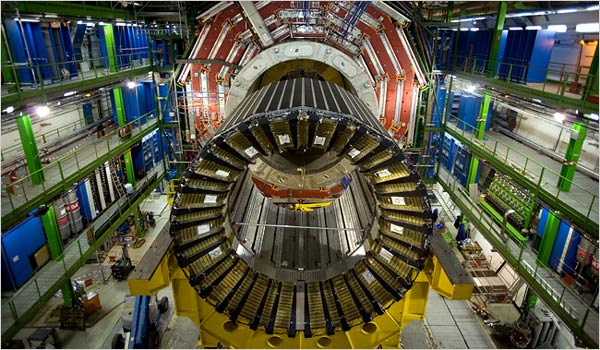
The claim of the CDF Collaboration that they have observed a new particle similar to a Z'-boson near 150 GeV decaying to 2 jets and produced together with a W-boson was just dismissed by their colleagues and competitors at the same Tevatron, the D0 Collaboration, that is working with the rather ugly and non-compact detector on the picture:
Study of the dijet invariant mass distribution in
pp → W(→lν) + jj final states at √(s) = 1.96 TeV
That's despite the fact that the CDF claim grew to 4.8 standard deviations - formally approximately 2 parts per million risk of a false positive - before it dropped to about 4.2 standard deviations (27 part per million risk of a false positive). Many people were almost certain that the signal had to be real.


D0 has analyzed 4.3 inverse femtobarns of their data. They formulated their opposition to CDF in this way: the probability that their (D0) signal is compatible with the CDF's claim of a dijet resonance near 145 GeV that has the cross section of 4 picobarns is just 0.000008, i.e. 8 parts per million.

Because D0 has obtained an agreement with the Standard Model, using the same data as the original CDF paper, and I believe that it's more nontrivial to get an exact agreement than to introduce a random error and inappropriate bump, I am almost completely convinced that D0 is right, CDF is wrong, and there is no bump. As a jury member, I say: Abazov beats Aaltonen! ;-) This expectation - that conservative physicists are almost always right and the "progressive" ones are almost always wrong - holds for the same reason why most big mutations of an organism are detrimental.

If you will hear someone saying that near-5-sigma "proofs" are incontrovertible, tell him or her about this story!


The CDF Bactrian (2-hump) camel is actually a D0 Arabian (one-hump) camel i.e. a dromedary. The 150 GeV hump was a Fata Morgana. Picture of D0 via Dorigo: click to get to his blog.

It's hard to figure out what CDF is doing wrong. But the evaluation of the jets and leptons is very complicated. If it were possible, the D0 people should try to apply their algorithms on the CDF data even though it's not quite possible because even the raw data differ because of the different detectors.

Needless to say, the likely CDF debacle is making their top quark-antiquark asymmetry doubtful and I just increased my subjective probability that this 3+-sigma result is wrong as well to 90 percent.

CMS at 190/pb: LHC avoids black hole production

The CMS Collaboration has published a new paper that also answers the question whether the Earth is going to be swallowed by a man-made black hole.


You can be sure that everything is fine and the Earth isn't being eaten yet. To be sure, here are the webcams near the CMS experiment and the LHC building. You may watch it to get assured that our planet is safe. ;-)


If you want to check that the LHC is safe with some music...

Indeed, even after 190 inverse picobarns, there's no black hole:
Search for black holes in pp collisions at sqrt(s) = 7 TeV
They studied final states with many - e.g. 10 - objects such as jets, leptons, and photons which carry a high energy such as 1 TeV or more. They would be a sign of an evaporating black hole. An agreement with the Standard Model background is found. I choose not to get excited by some occasional 2-sigma-like excess etc.

If there were low-energy string theory in Nature around us, I would still expect the string scale to be of order 3 TeV but the quantum gravity scale - the mass of the lightest black holes worth the name - would probably be significantly greater than that (an order of magnitude or more) and inaccessible at 7 TeV and maybe even at 14 TeV. So I personally view this experiment as a formality. But surprises may come at unexpected times...

Tuesday, June 7, 2011

CMS at 191/pb: no SUSY seen in Z + jets + MET

The CMS Collaboration has joined ATLAS and it began to release new papers with a significant amount of new data from the 2011 LHC run. The first paper is
Search for Physics Beyond the Standard Model in Z + jets + E^miss_T events at the LHC (PDF)
To process events where a Z-boson, missing transverse energy, and at least three jets are produced (quite complicated, right?), they use a new Jet-Z Balance (JZB) method; the Czech readers shouldn't confuse it with JZD which was a Czech kolkhoz (a farm stolen from the farmers and collectively owned by peasants obedient to the communist party) during socialism. And in the 0.191/fb of the 2011 data, there's clearly nothing significant.


You see that this is a slightly more contrived channel - but it is complementary to some of the most straightforward searches for the squarks and gluinos that ATLAS has already released. Some benchmark points were excluded, others were not. In particular, the benchmark points LM4 and LM8 - forget about my initials - are resilient. ;-)

But you can see that the number of relevant events is very low in this particular kind of search which makes all values of JZB above 50 GeV very noisy. There are only 20 events with JZB above 50 GeV and 6 events above 100 GeV. Because of the absence of hints, it's clear that a 5-sigma SUSY discovery in the channels that have already posted their 2011 data can't occur before a few femtobarns of the data - which can be rather soon, however.

Each major detector has already recorded 0.8/fb of the data. Note that the plan for the whole 2011 was just one inverse femtobarn!

Saturday, June 4, 2011

Indian SUSY island barely survived ATLAS' visit to 165/pb

On their conference notes page at CERN, the ATLAS Collaboration began to produce many new papers that use the 2011 data. At this moment, the fifth one is
Search for squarks and gluinos using final states with jets and missing transverse momentum with the ATLAS detector in sqrt(s) = 7 TeV proton-proton collisions (PDF)
They studied lepton-free events - dijet, three-jet, four-jet, with possible missing transverse energy - in order to find supersymmetry's gluinos. They didn't find any significant evidence of them which raised the lower bound to 725 GeV for the gluino mass in general and about 1 TeV for gluino mass if it is equal to the squarks' mass.


Miss Gluino, a vampire alchemist, is looking pale in the new paper. She will have to eat some blood, gore, and al-chemical food and become more massive in order to survive.


Clearly, the LHC is starting to penetrate to the territory of the parameter space that was possible according to all the pre-LHC data. As an example, the Indian supersymmetric island I was discussing in December 2011 survived once again, despite its having pretty low masses. But it had to be lucky.

The light stop is at 390 GeV, the light sbottom is at 720 GeV, other squarks are at 800-900 GeV while gluinos are at 934 GeV which is different. As you can see, the conditions of the new ATLAS paper are satisfied. But a single improvement that happens to produce the same negative outcome will eliminate the Indian supersymmetric island, too.

And maybe it will not and something more fascinating will take place.

The required amount of data has actually been accumulated by the LHC collider already, because each of the main two detectors at the LHC has collected over 650/pb at this point, which is 4 times larger than the dataset used in the paper we are discussing now, and the pile of the data is just waiting to be processed by the experimenters.

The latest gluino paper from ATLAS reports three events (two three-jet and one one-jet) that are close to the effective mass of 1.5 TeV but they're not enough to make me excited as much as the 3.34 TeV bump in the dijet spectrum.

Thursday, June 2, 2011

ATLAS: Standard Model passes 3 tests even at 205/pb

A rather remarkable triplet of similar events with the dijet energy near 3.33 TeV is the most spectacular hint of a new particle

Note that two days ago, I discussed the string theory Z'-boson explanation of the 150 GeV CDF Wjj bump. The newest paper predicted another Z''-boson with the mass of 3.* TeV - page 7 top. With a modest dose of optimism, ATLAS has just confirmed a stringy prediction.

But not so fast...


Phil Gibbs was the first man who spotted three radically new ATLAS preprints on a CERN page that at least two of us constantly watch. ;-)
Update of the Search for New Physics in the Dijet Mass Distribution in 163/pb of pp Collisions at sqrt(s) = 7 TeV Measured with the ATLAS Detector (PDF)

Search for high-mass states with one muon plus missing transverse momentum in proton-proton collisions at sqrt(s) = 7 TeV with the ATLAS detector (PDF)

Search for high-mass dilepton resonances in pp collisions at sqrt(s) = 7 TeV with the ATLAS experiment (PDF)
So far, the papers by CMS and ATLAS have only used at most 43 inverse picobarns of the 2010 data. Suddenly, they jumped to 205/pb, 163/pb of which was gotten in 2011.


The luminosity 43/pb in 2010 was small enough so that the chances of getting new exciting results were a matter of wishful thinking - a price in lottery (not necessarily the highest one) that physicists could win. Papers predicting new physics to be seen after 43/pb were "contrived" - the authors resemble gamblers who just want to imagine that sensations and Nobel prizes for them are waiting "right behind the corner".

While most authors who predict and discuss new physics at the LHC usually talk about 1/fb of the 7 TeV data or more, I think that those 200/pb = 0.2/fb is already starting to be significant and the three new papers that have found nothing are starting to substantially increase the probability that the LHC will see (almost) nothing - except for some kind of the Higgs sector.

I think that the first papers with a qualitatively higher luminosity contain much more information than the generic papers that were published "routinely". It's pretty clear that none of the standard methods can find anything new in 43/pb of the data and the new papers based on the 43/pb data quickly became redundant.

With the 205/pb of the data, it's different. The signal-to-noise ratio (the number of "sigmas") would more than double between 43/pb and 205/pb, so 2-sigma hints would become 4-sigma or 5-sigma signals in the new ensemble. That didn't happen.

However, three papers are still too little. It can't be excluded that these particular tests - dijet mass distribution and muon+MET states - were published first exactly because they don't see anything, so no further tests of their big and novel claims are needed (because there aren't any). However, the papers above already surely eliminate some models that were relatively close to the previous "boundary of our knowledge".

Some detailed impact of the three papers

The first paper on the dijet spectrum, extending this March 2011 preprint, mostly eliminates excited quarks and axigluons (and some RH black holes and perhaps other animals, but less clearly so). If you care about small hints, the first paper shows a 2-sigma excess for dijet energy of 3.333 TeV :-) plus minus 33 GeV or so, and they also show the picture of several events near this point. Because the expected number of events at even higher energy is lower, one event with the dijet energy of 4.040 TeV (the winner of the highest-energy championship) is enough to be a 1.8-sigma excess, too.

I would actually bet that the three events at 3.333 TeV could be real - not because it's a number that is guaranteed to excite crackpots but because the agreement in the energy between the three events is just striking. They show the events at 3.32, 3.35, and 3.36 TeV. The spread is just 30 GeV - even though the bin into which they have been thrown is something like 200 GeV wide! The probability that all the differences between 3 numbers in a 200-GeV-wide bin are at most 40 GeV is small - 10% - so it seems unlikely that it is a coincidence.

Well, I can make the case much stronger. There were exactly three events with the dijet energy between 3 TeV and 4 TeV. The probability that all 3 differences between the energies in the triplet are at most 40 GeV (which was the case with the 3.32, 3.35, 3.36 TeV) is just 0.5%. You might say that at a 99.5% confidence level, I showed that there is something real near 3.33 TeV. (I used a uniform distribution between 3 and 4 TeV but it's a good estimate because 3.33 TeV is not far from the center of the real distribution.) This 2.5-sigma argument of mine, if real, will grow to nearly 5 sigma if you use the 650/pb that have been accumulated as of today. Maybe, a 3.33 TeV particle rules. :-)

The second paper, updating this March 2011 paper, eliminates new charged massive gauge bosons - W-prime-bosons - because they would decay to missing energy (neutrino) plus the charged lepton, electron or muon, that they were searching for (and perhaps, it may rule out other animals, but less clearly so). I find W-prime-bosons just silly and marginally impossible even in theory (sequential standard model: WTF? SSM was the Czechoslovak Komsomol) so this particular conclusion is not a big deal, anyway. It requires some thinking to realize why these three papers don't exclude many models that are much more sensible.

The second paper shows the highest missing-transverse-energy event which has 1.35 TeV or MET. This whole paper reveals some excess at many energies but it's always within 2 sigma. No clumping of similar events so I can't use my argument that worked for the first paper.

Imminent flood of new results based on 2011 data

Within a few days, we should see a higher number of papers that use hundreds of inverse picobarns of the data and that will be more directly relevant for the search for more realistic new physics such as garden-variety supersymmetry. It's likely that in this case, ATLAS (the larger collaboration) will be faster in announcing their new results than the CMS (the smaller one). Note that after the 2010 run, it was the other way around.

Some of the potentially exciting results could be presented next Monday, in 3 days from now. Others may wait for the end of July, the EPS-HEP 2011 conference in Grenoble, the largest looming event in the field. For example, if the 3.33 TeV signal is real, each of the detectors may have 12 events strikingly accumulated near 3.32 TeV +- 20 GeV, while just a few between 3 and 4 TeV are elsewhere. This would already be a remarkable 7-sigma evidence for a new particle.

There may be many more signals that they already know. After the confusing recent leaks, omerta could have been imposed upon all the members and the announcement may be more grandiose as a result.

Low-energy excited strings at the LHC

Dieter Lüst, who was also excited by the possibility of a 3 TeV Z'' boson seen by ATLAS, has pointed out to me the following paper of theirs:
Dijet signals for low mass strings at the LHC
If string theory is realized in the real world by a brane world with old large dimensions, this fact will be easily discoverable by the LHC. The paper shows that the textbook Veneziano-like amplitudes could be independent of many details of the compactifications, at the leading level, and could be seen by huge cross sections, potentially right now.

If you forget that the 3.34 TeV particle is a Z''-boson, you might also say that it is a stringy harmonic. To make things numerologically funnier, the squared mass is 11.1 TeV^2. If you identify it with the N=2 excited mode of a string, the N=3 mode is at 11.1 x 3/2 = 16.65 TeV^2 which is the square of 4.08 TeV, very close to the other highest-energy event that was seen. ;-)

Whoever likes this argument will conclude that m(string) is equal to 2.35 TeV = 3.32 TeV / sqrt(2). Nice. Shmoits and Shwolins are already planning to buy lots of new underwear when they're reading these sentences and looking at the graphs above. ;-) Just to be sure, I am not certain that such signals will materialize in more complete data. Any of them. But they could. After many decades, a collider is running that is bringing us into a qualitatively new territory.

2.35 TeV is an excellent value for a string scale. Crackpots-slash-geniuses have already predicted that yablonons and magnetic monopoles exist exactly at the mass of 2.35 TeV. The former particle, named after a crackpot-slash-genius, could even be the first excited massive string mode. Moreover, the LHC was running for a while at the 2.36 TeV center of mass energy without realizing that it was fine-tuned to the string scale! :-) 2.35 TeV was also the mass of a fermion triplet dark matter while another paper quoted 2.35 TeV as the lowest bound for some dark matter mass. Good company! :-)

Tuesday, May 31, 2011

Seeing D-branes at the Tevatron and the LHC

As of 2011, no sane person seriously doubts that string theory is the right framework that describes the Universe around us. However, there remain uncertainties about the inner structure of the relevant string vacuum. String/M-theory possesses many four-dimensional solutions that qualitatively resemble our world.


Those solutions are connected on the configuration space of the theory and may be related by various dualities. However, the known stringy descriptions that are semi-realistic and weakly coupled may still be divided into several major categories:
  1. Weakly coupled heterotic E8 x E8 strings
  2. Heterotic M-theory in 11 dimensions; the strongly coupled limit of (1) with two end-of-the-world domain walls
  3. M-theory on singular 7-dimensional G2-holonomy manifolds
  4. Type IIA orbifold/orientifold braneworlds
  5. F-theory on local singularities
Somewhat independently of this classification, the models may reproduce the ADD old large dimensions - especially the braneworlds based on flat manifolds of extra dimensions in (4) and (5) - or Randall-Sundrum warped extra dimensions - especially types of (5) and maybe (3) and others.


The largest group (5) also includes the "generic" models - that one may describe as F-theory on Calabi-Yau four-folds - that have been used by the anthropic people. Because I don't consider the large number of models in a class to be a positive argument in favor of a scenario, this anthropic interpretation of the large class (5) will be ignored.

However, even independently of that, the group (5) contains some subgroups of "simplified" and "more specific" models that may be imagined in various ways and have various interesting properties. In particular, the group (5) includes the Vafa et al. bottom-up F-theory model building with singularities as large as the E8 singularity. Also, (5) includes the simple "moral" T-duals of the category (4) - type IIB braneworlds with D3-branes and similar things occupying a nearly flat space.

Relationships between the scenarios

While one cannot identify each model with "twin city" models in all other groups in a one-to-one fashion, it's still true that for various compactifications, there are dualities which are sometimes many-to-one equivalences. Let me mention a few of the basic ones that are enough to connect all five groups.

The group (1) is obviously related to (2) because (2) is the strong coupling limit of (1). Also, if the Calabi-Yau manifold in (1) is written as a T3-fibration, one may use the heterotic/K3 duality and obtain (3), the M-theory compactification with a K3-fibered G2-holonomy manifold. So (3) is connected to (1), too.

Locally on the compact G2-holonomy manifold, one may also try to shrink some cycles and get to a type IIA description. So (3) is related by the type IIA/M-theory duality to (4). And (4) is at least in some cases a T-dual of (5) - the usual dualities between type IIA and type IIB string theories. Let me just re-emphasize that this simple list is not exhaustive. There are other relationships between the vacua in different groups, too. Chances are that if you consider a vacuum in one group, you may learn a lot if you find a complementary perspective on it using a vacuum from a different group.

Advantages

The group (1) is the most field-theory-like scenario in string theory. It usually agrees with the conventional supersymmetric and grand unified model building in field theory even though there are some extra characteristic string effects modifying the grand unification, too.

The group (2) is similar except that the 11th dimension may be pretty large in which case one gets a higher-dimensional theory well beneath the Planck scale. At any rate, (1) and (2) are naturally exploiting the gauge coupling unification and other beautiful arguments of grand unified theories.

The group (3), much like (2), uses M-theory, the highest-dimensional description (if you don't count the fiber-like 2 extra dimensions in F-theory as dimensions). However, the group (3) doesn't contain the ends-of-the-world. Its singularities are pointlike which some people might view as more natural.

The braneworlds (4) and (5) may break the coupling unification and other advantages but they may have natural explanations for the fermion mass hierarchy and other things.

It's also interesting to look where the spectrum of the Standard Model is located. In (1), it lives everywhere in the 10D bulk (codimension 0). In (2), it lives in the 10D bulk on the end-of-the-world domain walls (codimension 1). In (3), it's on points of a 7-dimensional manifold (codimension 7). In (4), most of the matter depends on D6-branes and their intersections (codimension 3 or 6). In (5), it's mostly D3-branes (codimension 6 but also possibly 4 and 2).

Branewolds may have gotten some evidence

I would still say that (1) and (2) are the most motivated one but the possible observation of the 150 GeV new particle by the CDF, which might be a new U(1) gauge boson, has surely shifted my opinions a little bit, especially after I read a couple of cool articles about the realistic type IIB braneworlds. In fact, I hadn't previously read the following 3 papers:
There are many more articles that were needed for the list above but you may find some references in the papers above - e.g. in the last one. The last paper has already claimed that the stringy type IIB braneworlds may naturally explain the 140 GeV Tevatron bump we discussed yesterday.

I've seen various braneworld constructions but the Berenstein et al. 2001 construction strikes me as a very natural one. They study D3-branes on a nice orbifold of C^3 - an orbifold singularity that may occur in the 6 compact dimensions.

One orbifolds C^3 by a group known as Delta_{27} which is a "special" element in an infinite collection of finite groups Delta_{3n^2} for n=3. The group is generated by some added third roots of unity to z1,z2,z3 and by the cyclic permutation of z1,z2,z3: note how extremely natural this group is! And this natural orbifold in 6 extra dimensions pretty much produces the Standard Model - with 6 Higgs doublets.

Now, following the general description of Douglas and Moore for quiver diagrams, and particular derivations by Brian Greene et al. and others for the open string spectrum on the Delta orbifolds, Berenstein et al. have found out that one may get a very nice Standard-Model-like construction. It gives three generations - and in some sense, you may say that the number "3" is being linked to the number of complex compactified dimensions, so it is being "explained" here.

The fermionic spectrum, as described also in the 2008 paper mentioned above, looks very natural - and still "qualitatively differently" from the nice embedding in the grand unified theories. One has three stacks, morally U(3) x U(2) x U(1) gauge groups, and the charges of the fermions under them are

(1,1,0)
(2,0,0)
(-1,0,1)

(0,-1,1)
(0,2,0)
(0,0,-2)

Note that one includes all permutations of (2,0,0) and (1,1,0) - imagine that you flip the convention for the third sign - and the negatives of these vectors. Very natural, right? One may actually derive this spectrum from the non-Abelian orbifold of C^3 above.

However, you may define the hypercharge Y as the inner product of the six 3-vectors above with (-2/3,1,0) and one gets 1/3, -4/3, 2/3; -1; 2; 0. This hypercharge allows one to interpret the spectrum - six vectors above - as the left-handed quark doublet (3,2); anti-up-quark singlet (3bar,1); anti-down-quark singlet (3bar,1); left-handed lepton doublet (1,2); positron singlet (1,1); neutrino singlet (1,1) - an unnecessary right-handed neutrino.

Just to be sure, you may also define the right B-L quantum numbers of the spinors as the inner product of the six 3-vectors above with (-1/6,1/2,-1/2). A perfectly valid spectrum.

New U(1) groups

Now, these models have lots of new U(1)s - something that is really natural and generic within the stringy braneworlds. In the 2011 paper, Lüst and collaborators diagonalize the mass matrix for the new Z' and Z'' bosons, imposing various constraints, and they see that they can get the new 140 GeV particle.

When they do adjust the models in this way, they produce spectacular new predictions. In particular, there should be another Z'' boson at mass slightly above 3 TeV or so, potentially still available to the LHC, and the string scale at 5-10 TeV. A new collider would probably be needed for that but it is imaginable.

Imagine that the Tevatron 145 GeV signal is genuine and there will be an accumulating evidence supporting a new U(1) group. I would surely think that this would significantly increase the probability that the braneworlds are right.

If some other predictions of the model above were confirmed, it would be good to build a more powerful collider that would try to search for stringy physics at tens of TeVs because the possibility that the strings are almost behind the corner is just fascinating. It has always been too good to be true but if the experiments provided some evidence for some characteristic signatures of the braneworlds, the model could also be good enough to be true. ;-)

Strangely enough, these braneworld models predict some of the stringy physics to be almost as observable as supersymmetry - the superpartner masses may be a few TeV here. The idea that some more "specifically stringy" phenomena would be seen before supersymmetry used to look foreign or fantastic; however, showing that the expectations have been wrong or too modest is something that the experiments have the right to occasionally do.


Off-topic, Facebook: Today, Facebook made an interesting step in its (not quite) cold war against Google when it enabled the e-mail addresses on Facebook. If you have a Facebook account, you may start to use your.own.email@facebook.com that will be sent and readable on Facebook. Try to log into Facebook and check it.


Google Plus One: If you look at the bottom of any post, below "posted by", you will see the five "share buttons" and there is a new, sixth button, with "+1" in it.

Just like Facebook attacked Gmail today with its competition, Google just attacked the Facebook "like" button by its "+1" competition. See an explanation by Google. If you click at it, it will just add number "+1" for you only, and the people who are known to Google to be your contacts - via Gmail - may see on Google search pages that the page was "plus-oned" by you. Try it if you liked this article a bit. ;-)

So far, it doesn't seem to work reliably. You're more likely to see the "+1" button at the main TRF page, beneath each article's excerpt.


Bousso-Susskind crackpottery in Nude Socialist

I kind of expected it but now I know it. Even though the Nude Socialist journalist called Justin something asked me for a discussion and called me by phone for half an hour, after which he thanked and claimed that he began to understand what many-worlds of quantum mechanics etc. mean, he finally wrote a totally uncritical article promoting the Bousso-Susskind hypermultiverse crackpottery, denying that he had ever talked to me, or anyone else who realizes it is a crackpottery, after all.

This time I hesitated and finally said Yes but next time I will instantly say No to any single person from this crackpot tabloid. On the other hand, I must say that this new piece by Amanda Gefter in the same Nude Socialist is just flawless for a popular summary of the 150 GeV bump - even though it's true that she may have used many blogospherical sources that contain the same insight and facts.

Sunday, May 22, 2011

LHC surpasses an inverse nanobarn per second

As you can see in the right sidebar of this blog, the maximum instantaneous luminosity that the ATLAS detector has experienced so is
1100/μb/s = 34.7/fb/year.
So each major detector has surpassed 1/nb during the night. Congratulations! Note that because the nanobarns are inverse, the usual prefixes "micro, nano, pico, femto" are separated by factors of one thousand but in the opposite ordering.


Also, the integrated luminosity recorded by either detector has surpassed 400/pb (400 inverse picobarns) i.e. 0.4/fb (almost one half of the inverse femtobarn); each detector has experienced about 30 trillion collisions, most of them in 2011, of course. It seems extremely likely that an inverse femtobarn will be achieved in 2011 - and it's very plausible that many of them.

The luminosity (number of collisions per second, rescaled to other units) keeps on increasing by raising various quantities. See Phil Gibbs' blog for some details.

The LHC will continue through the end of 2012. I believe that because of further looming improvements, it will have collected 17/fb by that time - which is the approximate expected luminosity needed for a 5-sigma discovery of a 115 GeV Higgs bosons which is the most difficult mass where it can be hiding.

So by the end of 2012, the LHC should discover the Higgs boson - or find a scary crack in the Standard Model. Of course, it would be more interesting if the LHC found something much more exciting and rich than - and I hope that God will forgive me that I describe His namesake in this prosaic way - a single damn scalar particle! ;-)

Sunday, May 8, 2011

ATLAS at 94/pb: diphoton hysteria goes away

This is just a single link: in a list of ATLAS' notes, the last one is
Update of Background Studies in the Search for the Higgs Boson in the Diphoton Channel with the ATLAS Detector at sqrt(s) = 7 TeV
and it was released yesterday. Click at the images to see that after 94 inverse picobarns, there is absolutely no excess of diphoton events at 115 GeV.


This is a mostly official version of my previous report about the invalidity of the 115 GeV Higgs with 30-fold enhancement of the diphoton decays.

Tuesday, May 3, 2011

Why Frank Wilczek likes SUSY

Matthew Tamsett of the U.S. LHC writes about Frank Wilczek's recent talk in Texas that focused on supersymmetry.

If you have 80 spare minutes, here is a similar talk he gave a year ago - his J. Robert Oppenheimer lecture at UC Berkeley:


Based on Anticipating a New Golden Age (hep-ph).

The speaker comes to the podium around 11:00 and talks about the LHC and the Standard Model. By the way, the name of the Standard Model is "ridiculously modest". It should be called the Super Duper Heavenly Orgasmic Quantitative Holy Scripture by Wilczek and Friends. ;-)


Around 54:30, he switches to the topic of supersymmetry. Gauge coupling unification is his preferred argument for SUSY. The lecture is filled with animations, raps, and similar stuff. ;-)


In other supersymmetric news, Symmetry Breaking Magazine promotes a new method by Alves, Izaguirre, and Wacker to look for SUSY in the collider data.

They proposed a simple phenomenological method to search through various corners, including unexpected ones, and experimenters became fond of their method.

Wednesday, April 27, 2011

LHC: the 115 GeV "Higgs" evaporates after 100/pb

Jester has analyzed YouTwitFace, the new overarching social network, and concluded that ATLAS has looked for the diphoton decays in its 100/pb (one hundred inverse picobarns) of data - by now, it has recorded over 200/pb of collisions - and the 4-sigma signal of a decaying 115 GeV "Higgs" has gone away.


CMS has looked into the same channel and it sees no excess of diphoton events. So sorry, Ms Wu.

Monday, April 25, 2011

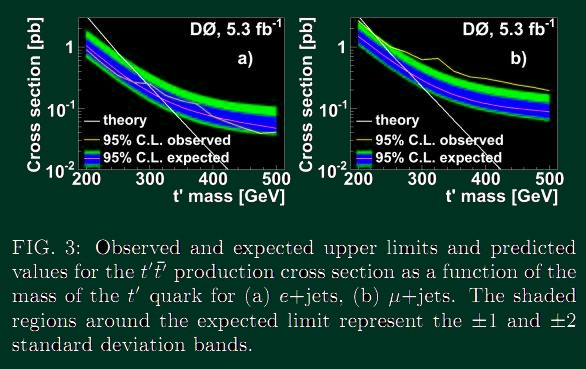
D0: 2.5-sigma evidence for a 325 GeV top prime quark


To make the jungle of suspicious yet unreliable bumps found by particle physics experiments even more convoluted, the D0 Collaboration at the soon-to-be-euthanized Tevatron is reporting a result that doesn't exclude the fourth-generation quarks quite as expected:
Search for a fourth generation t' quark in ppbar collisions at sqrt{s}=1.96 TeV
Events that look like a fourth-generation top prime quark decaying into W+jets were expected to lead to a 320 GeV lower limit for the top prime quark mass.


However, the actual picture looks different.


Click to zoom in

Because the W-boson is unstable, the experimenters only have to observe its decay product - either an electron or a muon in this case. And only in the muon (plus those jets) channel, there is an apparent 2.5-sigma excess (see the right picture) equivalent to 99.3% confidence level.

It's most accurately eliminated or explained if one assumes a fourth-generation t' quark of mass 325 GeV. Of course, it may be surprising why it doesn't show up on the left picture as well which is one of many arguments why this excess is probably just another fluke. Another argument is that to explain the bump, the usual couplings of the new quark would have to be increased so that the cross section is enhanced 3.2 +- 1.1 times. Much like in the strange LHC case of the 115 GeV Higgs, the observed signal is several times larger than one expects from the simplest theory.

The value of 325 GeV is provoking for one more reason. First, it's the current lower bound on the fourth-generation bottom prime quark imposed by Tevatron. But there's something even more "positive" about 325 GeV.

The D0's competing collaboration at the Fermilab, the CDF Collaboration, has seen some would-be particle - two surprisingly similar events - decaying to four muons. The mass of the hypothetical particle was 324.8 or 325 GeV. Of course, in their "speculative story", the CDF would interpret it as a Higgs boson decaying to ZZ (each Z later goes to two muons) - and a Higgs is very different from a fourth-generation top quark. But note that the muon in the final state is also shared in these two stories, much like the mass.

Thursday, April 21, 2011

ATLAS memo: 4-sigma diphoton bump at LEP's 115 GeV

An expectedly light Higgs boson could be showing up unexpectedly early at the LHC
Key update: After analyzing a higher amount of data, the 115 GeV Higgs signal has gone away (click)
Jester at Resonaances discusses a leaked internal memo of the ATLAS Collaboration at the LHC. See also Dorigo, Gibbs, Woit, Francis, Kavassalis, Wired, New Scientist, MSNBC.


If the internal note is authentic, which is extremely likely right now (but of course, it is not an official ATLAS document at this point!), and if the authors avoided silly mistakes and wishful thinking, which is not guaranteed (and it is particularly doubtful for those who doubted the 115 GeV LEP claims, because both claims involve Ms Sau Lan Wu - see her 2002 paper), ATLAS has analyzed 63.5/pb of data from 2010 and 2011 and it has observed a γγ resonance (excess of events with two photons) with a significance of 4 standard deviations - i.e. at the 99.994% confidence level.

The total invariant mass of the would-be particle is 115 GeV - the mass of the hypothetical Higgs boson that, according to ancient Greek legends, the LEP collider in the very same tunnel could have discovered a few weeks before it was shut down a decade ago.


There is a problem, however. If the excess were indeed due to the decaying Higgs bosons, theory predicts that it shouldn't have been seen yet! In fact, the observed cross section (probability of the production of the resonance) is about 30 times greater than the prediction from the Standard Model, assuming that the resonance is the Standard Model Higgs Boson, also known as the Weinberg toilet.


The Les Horribles Cernettes (LHC) girls perform their love song, Collider. However, the collider around them is not the LHC but LEP, the previous accelerator in the same tunnel that found hints of a 115 GeV Higgs boson right before it was shut down in 2000.

Various models beyond the Standard Model typically increase the discrepancy 30 to an even larger ratio. Some variations of NMSSM - the Next to Minimal Supersymmetric Standard Model - may decrease the multiplicative discrepancy from 30 to a few - by a factor of ten or more - but it may still way too large. See e.g. Ellwanger 2010 for a very suggestive method to increase the diphoton rate in NMSSM by a factor of six.

Of course, it's entirely plausible that the physicists have missed a possibility that the Higgs is at 115 GeV but because of a subtle feature of the particle, such as compositeness (which I don't like but consider it the most obvious example) or extra matter fields beyond the three generations we know, the diphoton decays are far more often than the Standard Model predicts.


Note that according to the graph above, at 115 GeV, only 1/500 of the decays (the fraction is called the branching ratio) of the Weinberg toilet end up with two photons. The two dominant decays are to bottom quark-antiquark pairs and WW pairs, and even decays to tau-antitau, ZZ, and charm-anticharm are far more frequent than the photon pairs.


ATLAS may soon be nicknamed Telemachus. Music by Don Garbutt

But because of some unexpected subtleties, Nature may ignore the Standard Model and prefer the decay to photon pairs. After all, the Next to Minimal Supersymmetric Standard Model doesn't have to be the last word. Recall that your neighbor who lives next to you doesn't have to be your best friend; it's often the next-to-next guy who is. ;-)

If you forget about the puzzles about the unexpectedly intense diphoton decays of the new would-be particle, the very mass of the particle would be perfectly consistent with supersymmetry, bringing the embarrassing doomsday closer to the anti-supersymmetric bigots of this world.

115 GeV is primarily the value of the Higgs mass that is overwhelmingly favored by supersymmetry. This point was conveyed extremely convincingly by Cassel et al. in 2010 who showed that the degree of required fine-tuning is dramatically minimized for a 115 GeV Higgs. In their statistical sense, a 115 GeV Higgs boson is the most robust and most accurate prediction of supersymmetry that we can make at the present state of knowledge. And it may be confirmed soon.

I guess that many people are going to think about the ways how to modify the existing models in order to predict much higher diphoton cross sections.

Your humble correspondent has predicted 115 GeV to be the most likely Higgs mass in dozens of contexts, so this blog is full of comments about a 115 GeV Higgs. In particular, I recommend you to reread
What a light Higgs boson would mean for particle physics (July 2010)
If the Higgs discovery is confirmed - and 5 sigma is already collected by now if those 4 sigma were real - it will be exciting, indeed. Theorists will have to struggle to explain the anomalously high diphoton branching ratio. But when those detailed complications are resolve, the LHC will have to work hard to discover the expected particles that really matter:


Superpartners at the LHC, by Don Garbutt

Monday, April 4, 2011

Is the top-antitop asymmetry due to stop squarks?

TRF has discussed the Tevatron-observed asymmetry in the produced top-antitop in January and March 2011.


Jester of Resonaances is reviewing the models that have been proposed to explain the discrepancy from the Standard Model - assuming that the discrepancy is real.


As I was previously sketching, the proposed models may be divided to three basic classes:
  1. a new "intermediate particle" appearing in the s-channel
  2. a new force mediated by a new "messenger particle" in the t-channel
  3. a new pair of particles that decay to top and antitop
We need some destructive interference with the Standard Model processes. So the first, s-channel category, has to include new "resonances" in the octet representation of colorful SU(3) of QCD. That includes various Kaluza-Klein modes of the gluons - e.g. in Randall-Sundrum models - as well as their "discrete extra dimensions" counterparts. One may add a "new deconstructed dimension" that has three points. That means that SU(3) is replaced by SU(3)^3, with the original SU(3) being the diagonal group. One can find three bifundamental fields in the octet representation that are friends of the normal gluon - they're the so-called axigluons.

In the second, t-channel case, the new particle may be octet or anything else - a singlet, triplet, sextet, sexist, feminist, or octet. I am a bit puzzled how those models predict that the force gets significantly turned on above those 450 GeV - Mandelstam's "t" is getting increasingly far from the positive squared mass of the new particle, isn't it?

Jester, who is going to lose ten thousand dollars in his bold 100-to-1 bet against your humble correspondent a year after the LHC discovers SUSY, must be praised for mentioning the third class as well. There is a paper,
Forward-Backward t tbar Asymmetry from Anomalous Stop Pair Production
by a Slovenian-Italian duo that says that the data can also be explained by the production of a stop squark and an antistop antisquark - two new guys who rapidly decay.


If quark-antiquark pairs are not your cup of tea, look at these two dogs in a restaurant! They're so civilized. Thanks to Gene

The mass of the stop should be about 190-200 GeV, just slightly heavier than the top quark, for the explanation to work. Such a stop (or antistop) should decay to the corresponding top (or antitop) together with a neutralino LSP whose mass should be a few GeV - they say 2 GeV. That's very light relatively to the energies we expect at the colliders but actually very good for the particle's job as a dark matter building block. And it's compatible with the experimental collider constraints, too.

There have been a couple of other dark-matter reasons to think that the dark matter particle could be as light as 7-11 GeV or lighter. So a vague speculator could mention that those different kinds of data may be pointing in the same direction.

By the way, I need to emphasize that if you find stop squarks' masses being just slightly above the top quark masses unnatural and unlikely, you are likely to be wrong. Stops and tops are the most important loop contributors to the Higgs mass - because of their large Yukawa couplings - and that's why stop squarks shouldn't be too different from the tops if things are natural in the "simple way". The masses of other fermions are less important for the hierarchy problem than the top and stop masses.

Friday, April 1, 2011

CMS will stop operations in September 2011

You must have already heard the news. The LHC has created black holes, thus demonstrating that Walter Wagner and other experts who have been warning the world about a possible doomsday at the European collider have been right.


Dr Walter Wagner explains how it was possible for him to predict that the LHC would destroy the world.

In fact, a much more dramatic event has taken place. Two black holes were created: one of them came from the ATLAS detector and the other from the CMS detector. They began to orbit one another. So far, the situation is stabilized but as soon as the black hole temperatures increase by 5.01 °C, they will swallow our blue planet.

Because this "bound state of two black holes" was totally unexpected by the LHC safety analyses, the CERN folks decided that one of the major detectors has to go so that the black hole bound state won't be created again, assuming that the heroic "Chamonix 50" sent by the Lifeboat Foundation will manage to save the Earth in this case.


Finally, CMS lost the battle because ATLAS has a higher number of members and they voted that CMS had to go. A particularly convincing argument came from Ms Fabiola Gianotti who complained that the CMS harbors a blogger, Mr Tommaso Dorigo, who leaked the information about the black holes. Ms Gianotti is the imcumbent head of the ATLAS experiment, soon to be replaced by Ms Heidi Cullen of the Union of Concerned Scientists.

While the particle physicists were ready to agree that it was appropriate to inform the public about the looming doomsday, Ms Gianotti has pointed out that Mr Dorigo has used the term "black hole" which was sexually obscene. Racially diverse members of the collaborations agreed. Mr Dorigo immediately quit blogging and Silvio Berlusconi's bodyguards will perform a plastic surgery on Mr Dorigo's face tomorrow.

Meanwhile, the LHC has found out that there is no Higgs boson. But, as you know, there has to be something that plays its role. A 16-year-old member has discovered that the "something" is actually the Hugs boson. Who could have thought? Consequently, physicists stopped searching for SUSY and started to search for MARY instead.

Finally, you may remember your humble correspondent's predictions that it was impossible for the crackpots who don't understand why string theory is inevitable given our knowledge of general relativity and quantum mechanics to ever understand those points. However, surgeons in the New York Presbyterian Hospital managed to successfully implant a chimpanzee brain to the skull of the world's most notorious crackpot and critic of string theory, Fecer Shmoit.

The surgery was successful and Mr Shmoit's IQ has been increased by 45 points. As a consequence, he could join Mr Clifford Johnson and change the primary topic of his blog to desserts and biking in New York. Congratulations, Mr Shmoit!

The surgeons are planning an even more ambitious surgery, that of Mr Pee Swolin. Good luck, Gentlemen!

Wednesday, March 30, 2011

Shimon Peres visits LHC

Haaretz, an Israeli left-wing daily, informs about the visit of Israeli President Shimon Peres to CERN.


Shimon Peres is talking to Fabiola Gianotti, the ATLAS experiment's head, and is observed by CERN director general Rolf Heuer. Amusingly enough, the official caption by Haaretz (or CERN) says: "Shimon Peres talking with CERN Director general Rolf Heuer at the particle accelerator in Geneva Tuesday." Can you spot the difference? :-) Well, yes, I would agree that in this case, she was discriminated against (by the left-wing sexist pigs). By the way, I think that the reason why Gianotti was omitted is that she has no male suit. Despite their obsession with clothes, women haven't managed to invent a counterpart of the male suit that would make them look uniformly serious. Shouldn't Gianotti just borrow a suit from a man?

Now, of course, Israel is in the process of becoming a full-fledged CERN member. This process is totally natural. There are 50 Israeli scientists working at CERN, not to mention much higher numbers of physicists of Jewish descent.


However, there has been some hesitation on the Israeli side when it came to the country's contributions to the experiment. More importantly, there's some clear opposition from the side of the old members - and, I would say, many generic physicists from those nations.
"People here may be smiling," said one member of the Israeli delegation. "But not everybody here is enthralled with Israel."
The French and the Britons have expressed reservations and the French are even worried that Israel's CERN membership would have a "detrimental effect on the French high-tech industry." Wow: I kid you not! The mysterious mechanism by which the membership of the Jewish state in a particle physics center could have a "detrimental effect on another nation's high-tech industry" hasn't been explained; they're probably afraid of the influence of the Internet Protocols of the Elders of Zion. :-)

The only explanations I can think of are related to this map of Europe in 2015:


This map has already become outdated a little bit: the Scandinavian country will no longer be called Sweden but the Polar Palestinian Authority (click). See also Goodbye Sweden. Thanks to Olda and Peter F. for the two videos.

Make no mistakes about it: there are lots of Israel haters among the particle physicists - and in many other "scholarly" groups in the West, too. The increasing influence of the Muslims in those countries is only making things worse. The differences in the opinions are significant: for example, I think that Israel should obviously become an EU member - and many key politicians in Europe agree - if the EU makes any broader sense. Some people don't like Israel even in a single scientific experiment.

Saturday, March 26, 2011

Buzz Aldrin dumped the LHC beam

If you continuously watch the LHC status, you must have noticed that on March 1st, 2011, a beam was dumped at some point. Why did it happen?

Well, it happened because they told the second man on the Moon, climate skeptic Buzz Aldrin, to press the red button, and he did so. ;-) Here a few words he said about the future of science:


Buzz Aldrin couldn't hide that particle physics wasn't his field but he's still such as skillful and charming speaker that what he had to say actually made some sense.


Via Symmetry Breaking

Friday, March 25, 2011

Spotlight on CERN


Prof Michal Spiro is the boss of CERN Council. We learn how the CERN is becoming a global organization. Two chaps are warning the viewers from shaking a hand of an antiperson. They're right despite their unconvincing T-shirts: one of them says "2+2=5" while the other translates "resistance is futile" to an inequality in Ohms.


We learn that Simon van der Meer died, Fabiola Gianotti joined Margaret Thatcher in the list of inspirational women, and so on.

Monday, March 14, 2011

Tevatron: Higgs mass probably between 114 and 157 GeV

Fermilab Today has informed us about the latest verdict of the Illinois collider center about the Higgs mass. The chart looks like this:


You see that the masses below 114 GeV are excluded by direct searches by LEP, the European collider who lived in the same tunnel as the LHC before the LHC bought an apartment over there. Indirect precision measurements exclude Higgses above 185 GeV.


The Fermilab's contribution is the excluded blue bar on the picture above. For example, in the very middle of it, you may find the predictions by Alain Connes. ;-)

At the 95% confidence level, they may exclude the interval of 157-173 GeV; at the 90% confidence level, they exclude the whole 156-183 GeV or so. With the less demanding 90% standards, only a tiny interval 183-185 GeV is left over there and it's very likely that the Higgs isn't hiding there. (Previously, the allowed island was 175-185 GeV or so, so the island has been mostly submerged.)

This approximately leaves the 114-156 GeV interval. Meanwhile, the ATLAS experiment at the LHC has analyzed some possible diphoton decays of the Higgs boson - see their future paper and PowerPoint - and look at the outcome:


Click to get to Francis the Mule blog

Now, I don't usually pay much attention to 3-sigma results (and sometimes even 5-sigma results must be considered critically) so you don't want me to hype 1-sigma results. Still, a Higgs below 120 GeV is getting more likely - by a factor of 3 or more - than a Higgs above 120 GeV. If the 1-sigma and 2-sigma bands were 3-sigma and 6-sigma bands, it would be a confirmation of something I still find to be the most likely outcome in the Higgs mass business.

Well, to be sure, D0 with 8.2/fb sees a nearly 2-sigma excess for the diphotonic Higgs decays below the 116 GeV mass, so in combination with CMS, one may get above 2 sigma.

LHC: a hardcore rumor

By the way, the LHC has begun the 2011 collisions, click at Status at atlas.ch.

However, I want to offer you a hardcore rumor. A D0 and CMS experimenter with a complicated four-syllable female Indian first name and a simple one-syllable Indian last name resembling the name of Saddam's political party has claimed, during a CERN video press conference a week ago, that the CMS has produced something that would really shock me and most others - namely the evidence of the compositeness of leptons.

If that's true, then whoops. It would be a spectacular discovery that would be very likely to kill GUT theories as we know them - and many other related paradigms. Please, try to understand that the rumor is pretty likely to be false; it's not even clear that the Indian physicist meant what it seemed to have been, and even if she did, there are many other places where your skepticism may get healthily incarnated.

Viable dark energy from Split SUSY

I liked this hep-ph preprint by Froggatt, Nevzorov, and Nielsen who combine Split SUSY, no-scale SUGRA, and some degenerate vacua to obtain realistic values of dark energy from intermediate SUSY breaking scales.

Monday, March 7, 2011

What if the LHC doesn't see SUSY?

A question from Nigel Seel at Physics Stack Exchange comes in four parts.
  1. What are the main problems which supersymmetry purports to solve?
  2. What would constitute lack of evidence for SUSY at the proposed LHC energy scales (e.g. certain predicted superpartners are not in fact observed)?
  3. Are there alternative theoretical approaches which would address the SUSY problem set and which would still be credible in such an LHC no-SUSY-scenario?
  4. Where would LHC-disconfirmation of SUSY leave String Theory?
He would like to think that these four points could be taken together as one question.

Answer by L.M.

First, let me emphasize something that is being covered by a thick layer of misinformation in the media these days: it is totally premature to conclude whether the LHC will see SUSY or not. The major detectors have only collected 45/pb (and evaluated 35/pb) of the data. The "slash pb" should be pronounced as "inverse picobarns".

The LHC is designed to collect hundreds or thousands times more data than what it has recorded so far, and it should eventually run at a doubled energy (14 TeV total energy instead of the current 7 TeV total energy). Each multiplication of the integrated luminosity (number of collisions) by 10 corresponds to the access of new particles whose masses are approximately 2 times larger or so. It means that the LHC will be able to decide about the existence of new particles at masses that are 4-16 times higher than the current lower bounds (16 also includes the likely upgrade from 2x 3.5 TeV to 2x 7 TeV).


There are at least two "mostly independent" parameters with the dimension of mass in SUSY - I mean m_0 and m_{1/2}. So the number from the previous sentence should really be squared, and in some sensible counting and with a reasonable measure, the LHC has only probed about 1/16 - 1/256 of the parameter space that is accessible to the LHC over its lifetime.

So the only thing we can say now is that SUSY wasn't discovered at an extremely early stage of the experiment - which many people have hoped for but this possibility has never been supported by anything else than a wishful thinking. Whether the LHC may see SUSY may remain an open question for several years - unless the LHC will see it much sooner than that. It's an experiment that may continue to 2020 and beyond.

We don't really know where the superpartner masses could be - but they may sit at a few TeV and this would still mean that they're accessible by the LHC.

Now, your questions:

What SUSY helps to solve

First, SUSY is a natural - and mostly inevitable - consequence of string theory, the only consistent quantum theory that includes gravity as well as the Yang-Mills forces as of 2011. See
Why string theory implies supersymmetry
In this context, supersymmetry is needed for the stability of the vacuum and other things, at least at a certain level. For other reasons, to be discussed below, it's natural to expect that SUSY should be unbroken up to LHC-like energy scales (i.e. that it should be visible at the LHC) - but there's no sharp argument that might calculate the superpartner scale.

Some string theorists even say that it should be expected that supersymmetry is broken at a very high scale (near the GUT scale or Planck scale) - because this is a "generic behavior" in the stringy landscape (the "majority" of the minima have a high-scale SUSY breaking which would make SUSY unavailable to any doable experiments) - so these proponents of the anthropic reasoning don't expect SUSY to be seen at the LHC. However, more phenomenological considerations make it more natural for SUSY to be accessible by the LHC.

Why? There are several main arguments: SUSY may offer a very natural dark matter particle candidate, namely the LSP (lightest supersymmetric particle), most likely the neutralino (the superpartner of the photon or Z-boson or the neutral Higgs bosons, or their mixture), that seems to have the right approximate mass, strength of interactions, and other things to play the role of the majority of the dark matter in the Universe (so that the Big Bang theory with this extra particle ends up with a Universe similar to ours after 13.7 billion years). See an article about SUSY and dark matter:
SUSY and dark matter
Also, SUSY with superpartners not far from the TeV or LHC energy scale improves the gauge coupling unification so that the strengths of the couplings get unified really nicely near the GUT scale (and maybe incorporated into a single and simple group at a higher energy scale not far from the Planck scale), see:
SUSY and gauge coupling unification
The unification in the simplest supersymmetric models is only good if the superpartners are not too far from the TeV scale - but if they're around 10 TeV, it's still marginally OK. The same comment with the same value 10 TeV also holds for the dark matter job of the neutralinos discussed above.

Finally and most famously, SUSY with superpartner masses not far from the TeV or LHC scale stabilizes the Higgs mass - it explains why the Higgs mass (and, consequently, the masses of W-bosons and Z-bosons, among other particles) is not driven towards a huge energy scale such as the Planck scale by the quantum corrections (with loops of particle-antiparticle pairs in the Feynman diagrams). Those otherwise expected quantum corrections get canceled at the TeV accuracy if the superpartner masses are near a TeV - and the resulting Higgs mass may then be naturally in the expected 100 GeV - 200 GeV window with an extra 10:1 luck (which is not bad).

The lighter the superpartner masses are, the more "naturally" SUSY explains why the Higgs mass remains light. But there is no strict argument that the superpartners have to be lighter than 1 TeV or 10 TeV. It just "sounds strange" if they were much higher than that because a non-negligible portion of the hierarchy problem would remain. Still, Nature may have chosen just to "improve" the hierarchy problem instead of "fully solving it". See a text on SUSY and the hierarchy problem:
SUSY and hierarchy problem
One may say - somewhat misleadingly - that experiments already do disprove 99.999999999+ percent of the natural a priori interval for a conceivable Higgs mass in the Standard Model. SUSY changes this counting - the probability that the Higgs mass ends up being approximately as low as suggested by the electroweak observations becomes comparable to 100 percent according to a SUSY theory. To agree with other available experiments, SUSY needs to adjust some other parameters but at good points of the parameter space, none of the adjustments are as extreme as the adjustment of the Higgs mass in the non-supersymmetric Standard Model.

Can we decide whether SUSY is there at the LHC?

SUSY may hide for some time but the LHC is simply scheduled to perform a certain number of collisions at a certain energy, and those collisions may eventually be studied by the most up-to-date methods and the evidence for SUSY will either be there in the data or not. Some phenomenologists often want to stay very modest and they talk about numerous complex ways how SUSY may keep on hiding - or remain de facto indistinguishable from other models. However, sometimes the very same people are capable of reverse-engineering a randomly constructed man-made model (fictitiously produced collision data) within a weekend: these have been the games played at the LHC Olympics. So I don't really expect too much hiding. With the data, the fate of the LHC-scale SUSY will ultimately be decided.

Obviously, if SUSY is there at the LHC scale, the LHC will eventually be discovering fireworks of new effects (SUSY is also the most attractive realistic possibility for the experimenters) - all the superpartners of the known particles, among other things (such as an extended Higgs sector relatively to the Standard Model). Their spins and couplings will have to be checked to (dis)agree with those of the known particles, and so on. All the masses may be surprising for us - we don't really know any of them although we have various models of SUSY breaking which predict various patterns.

Alternatives in the case of SUSY non-observation

The dark matter may be composed of ad hoc particles that don't require any grand structures - but such alternatives would be justified by nothing else than the simple and single job that they should play. Of course that there are many alternatives in the literature but none of them seem to be as justified by other evidence - i.e. not ad hoc - as SUSY. I think that in the case of no SUSY at the LHC, the LHC will remain some distance away from "completely disproving" SUSY particles as the source of dark matter because this role may work up to 10 TeV masses or so, and much of this interval will remain inaccessible to the LHC.

So the LHC is a great gadget which is stronger than the previous one - but one simply can't guarantee that it has to give definitive answers about all the questions we want to be answered. This fact may be inconvenient (and many laymen love to be promised that all questions will inevitably be answered for those billions of dollars - whether it's true or not) but it's simply a fact that the LHC is not a machine to see every face of God. There are various alternatives how to solve the hierarchy problem - technicolor (which has been really squeezed into the corner), the little Higgs model (based on deconstruction), the Randall-Sundrum models (which may be disproved at the end of the LHC, too - the LHC is expected to decide about the fate of each solution to the hierarchy problem although they may always remain some uncertainty), etc. - but I am convinced that even in the case that SUSY is not observed at the LHC, superpartners with slightly higher masses than those accessible by the LHC will remain the most well-motivated solution of the problems above.

Of course, if someone finds some better new models, or some amazing experimental LHC (or other) evidence for some existing models, the situation may change. But right now, away from SUSY, there are really no alternative theories that naturally explain or solve the three problems above at the same moment. This ability of SUSY to solve many things simultaneously is surely no proof it has to be the right solution of all of them - but it is a big hint. It's the reason why particle physicists think it's the most likely new physics at this point - a conclusion that may change but only if new (theoretical or experimental) evidence arrives.

While it is clear that the absence of SUSY at the LHC would weaken the case for SUSY and all related directions, I am convinced that unless some spectacular new alternatives or spectacular new proofs of other theories are found in the future, SUSY will still remain the single most serious direction in phenomenology. In formal theory, its key role is pretty much guaranteed to remain paramount regardless of the results of LHC or any conceivably doable experiments. The more formal portions of high-energy theory a theorist studies, obviously, the less dependent his or her work is on the LHC findings.

I don't have to explain that the absence of SUSY at the LHC would mean a sharper splitting of the particle physics community.

Absence of SUSY and string theory

Clearly, if no SUSY were seen until 2012 or 2015 or 2020, the critics of string theory would be louder than ever before. Somewhat paradoxically, within string theory, the anthropic voices and attempts to find a sensible vacuum with the SUSY breaking at a high-energy scale would strengthen. But nothing would really change qualitatively. The LHC is great but it is just moving the energy frontier of the Tevatron at most by 1-1.5 order(s) of magnitude or so.

If there is some non-SUSY new physics found at the LHC, most particle physicists will naturally be interested in whatever models that can be relevant for the new observations. If the LHC sees no new physics, e.g. if it only sees a single Higgs boson, and nothing else ever appears, the current situation will qualitatively continue and the tensions will only get amplified. (The determination to build a collider after the LHC may weaken, too.) Serious physicists will have to continue their predominantly theoretical and ever more careful studies (based on the observations that have been incorporated into theories decades ago) without any guidance about new physics from the available new experiments (simply because there wouldn't be any new data!) - while the not so serious physicists and people around science will strengthen their hostile and utterly irrational claims that physics is no longer science.

Sociologically, the situation would almost certainly become unpleasant for good physicists and pleasant for populist and uneducated critics of science who are not really interested in the truth about the physical world. But Nature works in whatever way She does. She is not obliged to regularly uncover a part of Her secrets, not even if we pay ten billion dollars each decade.

A paper with the same question in the title

Amusingly, there exists a 2-week-old preprint by 8 authors:
What if the LHC does not find supersymmetry in the sqrt(s)=7 TeV run?
You may see that the question in their title is almost identical to Nigel's question at Physics Stack Exchange.

These authors' answer is much like my answer above: if the LHC is not found during the 7 TeV run (that should continue until the end of 2012), SUSY would still remain an acceptable solution to all the problems I mentioned above; just our idea about the masses of the strongly interacting superpartners (gluinos and squarks) would have to be raised above 1 TeV or so. It's pretty natural for those strongly interacting superpartners to be the heaviest ones among the superpartners - which automatically makes them harder to be seen at hadron colliders such as the LHC.


Supersymmetry - King Felix EP - 2010 by Laurel Halo

See also What if the LHC sees SUSY. Although it's the far more interesting question and scenario, it's apparently the politically incorrect one to even ask. ;-)

Saturday, March 5, 2011

CDF: a new confirmation of top quark pair asymmetry

Just a few links and remarks.


In January, we looked at a reported huge 3-to-1 asymmetry of the top-antitop (vs antitop-top) quark pairs produced inside the CDF detector at the Tevatron. The effect occurred for high invariant masses - above 450 GeV - and depended on muons.

The strength of the deviation was 3.4 sigma.


Now, Jester has pointed out that a new two-sigma deviation has been publicized by an Asian-Slovak-Californian CDF group.

The new deviation doesn't depend on muon detection - it almost completely boils down to electrons. So the case for the hypothetical asymmetry in the actual laws of physics - that dramatically exceeds the asymmetry predicted by the Standard Model - has strengthened again.

Recall that it is not trivial to obtain such a large asymmetry as a prediction from a theory and the most straightforward way to get such an asymmetry from an interference is to allow, aside from an intermediate gluon, another bosonic intermediate state with the same (adjoint) color charge - such as a heavy gluon in RS-like theories with extra dimensions. Unless I am missing something, a heavy scalar in the adjoint could do the job, too.

More speculatively, the effect could be caused by some coordinated flavor-changing processes, turning the initial light quarks to top quarks; by excited stringy-like cousins of the gluons; or by mundane physics of the Standard Model that has been misunderstood (for example, maybe, one should consider some top-antitop bound state in the adjoint as an independent possible intermediate state?).

Of course, if the experiments continued to suggest that something like that exists, it would be kind of surprising although it is not quite true that such models are completely unfamiliar in the literature. For example, so far, a convincing experimental discovery of a new boson in the adjoint would leave the theorists asking the familiar question "Who ordered that?"


Lorentz invariance at the Planck scale

I decided not to write a separate blog entry about this topic. But as you may know, the Fermi satellite has shown that the Lorentz violation even at the Planck scale must be much smaller than O(100%).

However, I wasn't quite aware of the fact that the vacuum birefringence allows one to make a vastly more stringent ccnstraint than the measurement of the simple delay of the photons: the Lorentz violation at the Planck scale - by the 1/M_{Pl} operators - has to be smaller than 85 x 10^{-15}: the key symmetry is more accurate than a part per trillion. A gamma ray burst was used, too. See
New Limits on Planck Scale Lorentz Violation from Gamma-ray Burst Polarization