Showing posts with label mathematics. Show all posts

Friday, May 13, 2011

Precalculus and chemistry solved: WolframAlpha iOS apps

In January, I wrote about WolframAlpha iPhone apps for algebra, calculus, and music. There also exist astronomy and multivariable calculus apps.

Your humble correspondent could finally test two new "course assistant" apps described at the WolframAlpha blog. They help users to master and solve:
Both course assistants are cute. The user interface is clean and comprehensible and the results are relevant.

There are also lots of details that make the experience more pleasant and the usage more effective. One of them is good for testers such as myself: whenever you're using a tool in the app and you have to enter something, there are always pre-filled input parameters that produce an interesting enough output. You may modify them or discard them but you're never lost by having a tool with no idea how to get an interesting answer from it.

For another example, when you're supposed to enter an element, more general chemical formula, or a mathematical expression for a function, you always get a new relevant keyboard. This is just an example of the screen when you're trying to get the electron configuration of silicon.


You can imagine how many hours one could have save at school - and not only at school - if he had (and was allowed to use) these apps. I am convinced that if you are a student who hasn't memorized all of precalculus and general chemistry or if you use these things in your job or if you know a kid or someone else who needs to solve similar tasks, you should buy the $4.99 apps.


Let us look at the precalculus app. The first thing you will find is a menu with 8 categories; combinatorics didn't made it to the picture below.


...

Some of them have submenus. You enter your problem. Depending on the context, you write the expressions with a certain kind of a keyboard. And of course, the application solves your problem in an appropriate way.


In this case, you obtained a plot. Of course, in many other cases the result is more "talkative". When you're solving a trigonometric equation, it may have many solutions.


...

Sometime in the past, I would be tutoring all these things - how to draw vectors, compute their sums, dot products, other products, how to draw functions, solve sets of linear equations, and so on. This app would have surely been useful for "my" student who hadn't really learned those things and gave up. ;-)

In March, in the article called Michael Green: Math Classes Are Boring, I have been thinking about whether or not the math classes should be made easier and whether the hard work should be eliminated. My answer was essentially No.

These apps show that there are lots of mechanical things that students are required to do and that may be fully replaced by software - such as the apps based on WolframAlpha. (Yes, the apps need to connect to the Internet.) However, I would much happier if the buyers were not using the app just to cheat - whenever the teacher allows it. They should play with it and see what happens. They should learn.

An app may make learning more efficient but I don't think that it should replace it. When you don't spend enough time by doing hard mechanical work, you won't understand what's happening inside similar apps. Consequently, you will be unable to even formulate the right questions.

If someone uses the Precalculus App to cheat, he will experience some fun things. In most cases, the solution is given with the full treatment that a high school or elementary school teacher may expect. But sometimes it just spits the right result. If a student copies it, it may be suspicious how he got it.

The suspicions may turn into a self-evident fact once an otherwise problematic basic school student copies some trigonometric results that involve exp(ix) or combinatorial results that include the Gamma function - and be sure that the app naturally returns them (at least as one of the ways to express the result) in several cases because the underlying Mathematica is assuming functions of complex variables at the end.

The general chemistry app is divided into 9 main categories; the 3 that didn't get to the picture below are acids & bases; the nucleus; units & chemical properties. Many of them have subcategories and even subsubcategories but the hierarchy is natural.


...

The problems it can solve deal with as simple things as unit conversions, counting of protons in elements, simple inorganic compounds as well as many complicated things such as finding the equilibrium concentrations in chemical reactions etc. Even some of the simple graphs and tables you get are revealing.


For example, I would be sure that the (first) ionization energy of elements - alkali metals have been marked as red by the user (and they have a very low ionization energy) - has to look like this but I don't think that this graph has been shown to us in chemistry classes. Of course, you will find lots of others.


...

In the example above, the user enters a particular compound and some information that determines how much of it you have in a solution and the app describes the properties of the solutions in many other ways.

The examples above are somewhat obscure but there's a lot of the typical calculations, table data, conversions, lists of elements and acids and other things that belong to various groups - whatever you would expect from a good "intelligent textbook".

Recommended.

Friday, April 29, 2011

John Baez, octonions, and string theory

John Baez has always been obsessed by octonions. He sees them everywhere. I love octonions but I realize that they don't play much role in most of physics - and not even in most of string theory.

In 2009, I wrote a related article
John Baez, M-theory, and spinors
Scientific American has just published a text by John Baez and his student John Huerta,
The Strangest Numbers in String Theory (demo; free version in 1 month)
The first fact I find utterly crazy is that two people who manifestly and demonstrably don't understand string theory - not even at the undergraduate level - are writing articles for widely read journals pretending to be scientific magazines with "string theory" playing the role of one half of the title. As I will argue, they are really abusing the stellar brand of string theory to promote their idiosyncratic bullshit.


The SciAm article is a simplified version of this more technical article
Division Algebras and Supersymmetry II by John Baez
posted at Jacques Distler's n-category and marijuana coffee shop. As sketched in my 2009 blog entry, Baez is obsessed by the observation that the classical string theories in D=3,4,6,10 - which use spinors with different reality and chirality projections - can be mapped to R,C,H,O, the four division algebras of dimensions 1,2,4,8.

In some sense, SL(2,O) may be interpreted as SO(9,1).

However, that's it. The actual structure of the octonions - their multiplication table whose characteristic automorphism group is G_2 - is not really used in SO(9,1) in a useful way. And if this table and the G_2 symmetry appears at a certain stage, it immediately disappears.

Moreover, the minimal superPoincaré algebras in 3,4,6,10 dimensions are far from being the only four superalgebras in their class. They're not even the most interesting or most symmetric ones. They're just algebras in four dimensionalities D such that D-2 - the number of physical polarizations of a gauge boson - is a power of two. It has to be a power of two in a minimal supersymmetric gauge theory because the number of bosonic polarizations has to match the number of fermionic polarizations and the latter come from a spinor; I don't need division algebras to prove that. Also, I don't need division algebras to prove that minimal super Yang-Mills theories can only exist in these four dimensions.

Also, the "other remarkable structures" that directly come from the R,C,H,O sequence are not that interesting. He also talks about membranes in 4,5,7,11 dimensions (not surprising that they have the same counting of physical degrees of freedom - it's just double dimensional reduction). Except for the last one, they're not terribly interesting theories or vacua. So the detailed data refute Baez's hypothesis; he clearly doesn't care. Also, the R,C,H,O argument doesn't really show why/that only the 10- or 11-dimensiona case is consistent at the quantum level (as a separate theory). This whole R,C,H,O perspective on the landscape of string/M-theory vacua is naive at the level of a kindergarten kid. You simply can't understand the secrets of string theory by learning the sequence 1,2,4,8.

In the slow comments under the 2009 blog entry, Robert Helling argued that there is a lot of interesting fog about the closure of the supersymmetry algebra etc. I find this whole approach to these issues irrational.

There's lots of fascinating, still poorly understood mysteries about string theory's internal mathematical consistency. But the topics that Baez, Huerta, Helling, and others are talking about are pretty much exactly those where the mystery has already been fully eliminated. The mysterious links to pure mathematics continue to exist but you must get much deeper to uncover them.

There are simple ways to prove that 3,4,6,10 are the relevant dimensionalities for the classical superstring - but only D=10 is the actual dimension that is allowed at the quantum level. However, counting of the dimensions is one of the most elementary facts about string theory. All the cancellations that Baez et al. hype can be easily proved - in many different ways, in fact. Joe Polchinski boasts that volume I of his book derives the critical dimension of the bosonic string theory in 7 different ways. So why is there so much ado about nothing? Our ability to derive results in 7 different ways shows that we kind of understand it. Those ways also connect different portions of mathematics - but it is the whole structure of string/M-theory, and not a division algebra, who unifies all this stuff.

Moreover, as hinted in the previous sentence, what I am really irritated by is Baez's obsessive tendency to reduce all the mathematical cleverness of string theory to the division algebras in general and octonions in particular. His way of looking at all these things shows that he is nothing else than an irrational numerologist who can never distinguish real insights from superficial distractions - and who apparently doesn't want to distinguish them.

The division algebra is just one way to look at all the issues linked to 7 imaginary units with the G_2 automorphism group, and all the associated algebraic structure. The octonions as an algebra are just one possible corollary or intellectual projection of the structure behind it. And even all these structures combined are just a totally minuscule portion of the string theory's wisdom, much like John Baez's knowledge of string theory is an infinitesimal fraction of the knowledge of a good graduate student.

So the article hyping a set of a few simple mathematical observations is just pathetic. It's not really demonstrably wrong - unlike Garrett Lisi's pseudoscientific "theories of everything" that can't agree with the most elementary facts of particle physics such as parity violation. But it's still morally wrong because it totally distorts what is understood and what remains mysterious about the remarkable mathematical structure we still call string theory.

This distortion shouldn't be unexpected from authors who don't have a clue about string theory. But this is no real excuse because Scientific American shouldn't be publishing stuff written by people who don't know what they're talking about.

Friday, February 25, 2011

The Hodge-minimal Calabi-Yau three-fold

Today, I recommend you this preprint by Herr Volker Braun of Dublin:
The 24-Cell and Calabi-Yau Threefolds with Hodge Numbers (1,1)
He constructs the "simplest" six-dimensional Calabi-Yau manifold we know.


Click to zoom in.

This diagram shows all the known Calabi-Yau spaces with small Hodge numbers, h^{1,1}+h^{1,2} < 25. The colors indicate how those spaces were constructed. Note that both of these numbers have to be positive. The world's catalog of known Calabi-Yau spaces indicates that h^{1,1}+h^{1,2} < 503 for all Calabi-Yau shapes.


The left-right symmetry of the graph above is nothing else than the mirror symmetry: it exchanges h^{1,1} and h^{1,2} which means that it preserves their sum (y coordinate on the graph) but changes the sign of their difference (x coordinate).

The new entries, showed as purple disks or pieces of disks on my version of the graph above, were constructed by Braun as free quotients of the 24-cell hypersurface; this hypersurface is a "Platonic 24-hedron" in 4 spatial dimensions, analogous to the regular Platonic polyhedra in 3 dimensions. (There are six such polytopes in 4 dimensions.) Its boundary is composed out of 24 mundane octahedra.


The 24-cell polytope. Click to see Wikipedia.

If you look, the minimum entry with the values h^{1,1} = h^{1,2} = 1 was missing so far. Now the hole is filled. Note that the anthropic people wouldn't be interested in such manifolds because they're too constrained; there are not too many cycles that may carry a large number of fluxes. The misanthropic people such as myself think that these "minimal" surfaces are the most important ones - and arguably the most relevant ones physically and cosmologically - because they are very constrained. ;-)


The singer, Jonathan Mann, wants to understand string theory and maths. He wants to hang up with Edward Witten, too. :-) Thanks to Sarah Kavassalis.

Thursday, February 17, 2011

Are pathological mathematical structures important in physics?

Javier was intrigued by the following preprint:
Quantum D-branes and exotic smooth R4
The authors argue that strings or D-branes may propagate on backgrounds that are homeomorphic to R^4 but not diffeomorphic to R^4 - some four-dimensional space with an inequivalent "smoothness" structure. It's an interesting concept but I don't understand the paper.


A forefinger of a person whose DNA program has mutated to include an infinite loop. Governments use the same arm when they offer a hand to the individual citizens.

I haven't changed my opinions about most of the "key philosophical questions" during the last 20 years (and, in many cases, 30 years) but the relevance of seemingly pathological mathematical structures for physics is an aspect where a gradual transformation of my opinions has become undeniable.

Discontinuous and pathological structures

Some people must have always been obsessed with discrete constructions and combinatorics. I wasn't. Once I had learned some complex analysis 30 years ago, I was convinced that the fundamental objects underlying both mathematics and the physical world have to be continuous and beautiful, in a sense that includes some smoothness.

Discrete objects are just degenerations or incomplete descriptions of the continuous ones; in other words, the discrete objects' measure is zero within the space of all objects. They're degenerated and pathological, especially if they require a procedure to be repeated infinitely many times. The (approximate) fractal above is meant to convey my feelings about some pathological mathematical structures.


This philosophical thesis may be fine as a slogan but it doesn't answer all questions in maths and physics. I am still confident that it is a very helpful guide in much of physics, up to the conventional quantum field theory and string theory, but just like any philosophy, it is misleading in many particular contexts.

As you may expect, the rest of the text will be dedicated to the counterexamples and necessary revisions of the thesis above.

Infinitely differentiable functions

Complex numbers have the advantage that each N-th order polynomial equation has N roots or solutions - some of them may coincide. Polynomials are perfectly smooth, infinitely differentiable functions that may be fully and uniquely reconstructed from their Taylor expansions. Exponentials and sines and cosines seem to have the same property despite the fact that they can only be written as polynomials of the infinite order.

So of course, my attitude used to be that we wouldn't ever need any functions that can't be defined by their Taylor expansions. Arguments that require non-smooth functions to be used are either approximate, misleading, or downright wrong. You don't need any perverse functions and the people who study them are perverts, too.

That's a great attitude that allows you - and has allowed me - to get pretty far. However, as it turned out, it has its limitations. Once upon a time, in a mathematics handbook for engineers, the sort of books that have taught me a lot, I saw some explanations of the Fourier analysis. It was very neat and at the beginning, it seemed to be compatible with my philosophy. Combinations of sines and cosines are perfectly nice functions, aren't they?

However, I was shocked to read that even non-smooth - and discontinuous - periodic functions may be written using the Fourier expansions. That's terrible! How can ugly, discontinuous, pathological discontinuous functions arise from a combination of the beautiful ones? Moreover, I was sure that I had to allow infinite sums of beautiful objects, to be able to do pretty ordinary things (e.g. Taylor expansion for the exponential).

It turned out that the beautiful objects - infinitely smooth functions - were not closed under the infinite summation (and other similar operations). One can't completely avoid the ugly objects.

Poles, non-perturbative effects, asymptotic series

Obviously, there are many other subtleties that blur the boundaries between the "beautiful" and "ugly" objects. Taylor expansions often have a finite radius of convergence; this fact is a symptom of singularities of the function in the complex plane.

Another surprise - that emerged in physics - was the existence of non-perturbative contributions. If you consider the function
f(g) = exp(-1/g2),
and you define f(0)=0, it's a perfectly smooth function of the real variable g. However, its Taylor expansion is
0 + 0g + 0g2 + 0g3 + ...
which obviously doesn't converge to the original (nonzero) function. All the terms in the Taylor expansion vanish because the N-th derivative of f(g) always contains the exp(-1/g^2) factor, and this factor goes so quickly to zero near g=0 that it beats any ratio of polynomial functions of g that you also produce by the differentiation. The function starts to rise from zero extremely slowly and gradually so that the Taylor expansion can't see the rise at all.

This function f(g) is not just a curiosity; if g is interpreted as a coupling constant, physics is actually full of such terms in the quantum amplitudes. They're the non-perturbative corrections - coming e.g. from instantons - because they can't be correctly expressed by the Taylor series.

Such insights contradict the naive intuition that the Taylor expansions are good to describe "any natural function". This assumption is simply showed to be wrong. It's wrong at a rigorous mathematical level. But more importantly, it's also morally wrong, i.e. wrong when it comes to its naturally guessed physical implications.

A good initial intuition is very important for a person to make some progress; however, his ability to correct mistakes and to abandon prejudices that are shown to be wrong is at least equally important. The idea that all functions that naturally occur in physics may be fully replaced by their Taylor expansions is wrong - even though one needs a high precision for the flaw to reveal itself.

Another, related surprise is that the Taylor expansions one obtains from perturbative quantum field theory (or perturbative string theory) don't converge even though they're the best perturbative approximations of answers that exist and that are finite. The perturbative expansions are the so-called asymptotic series. At the beginning, the terms are decreasing because we're adding powers of g. However, the prefactors ultimately win and the terms start to grow again. The minimum term - i.e. the uncertainty of your sum if you try to calculate it as exactly as you can (by summing a subset of the series) - happens to be of the same order as the first non-perturbative contributions.

I don't want to explain these things pedagogically here; after all, most of these topics have been covered on this blog many times in the past. Instead, the point of this essay is to emphasize that even refined, tasteful expectations about the "ethics" that all mathematical structures should obey may be shown to be wrong and one must carefully listen to Nature - and to Her native language, mathematics - if he or she wants to penetrate deeper under Her skirts.

Of course, I still believe that analytic functions are totally crucial in physics and it's always sensible to ask what happens with functions if we continue them to complex values of energies, momenta, and even complex values of distances and times. However, all the lessons about the divergences, non-existence of Taylor expansions for some functions etc. have to be respected; they cannot be denied. And they invalidate many conclusions that are based on naive reasoning.

If I return to the discontinuous functions that admit a Fourier expansion, it's another lesson. Various functions such as the wave functions in quantum mechanics have no reason to be differentiable infinitely many times (although every function that appears may be approximated by totally smooth functions arbitrarily well). Instead, we allow wave functions that are discontinuous - and even wave functions that are distributions rather than functions (distributions are even more "unsmooth" generalized functions than discontinuous functions). The distributions actually turn out to be some of the most natural bases - bases of eigenvectors of observables with a continuous spectrum.

Non-measurable sets

Leibniz and Newton invented the integrals and much of the maths behind them was very pragmatic for a few centuries; top theoretical physicists would use a laissez-faire approach to the formalism. Do whatever makes sense to you. We could say that Newton's methods to deal with the integrals - and derivatives - resembled the approach of contemporary engineers. But it has simply worked, at least for the people who were competent.

Mathematics got more strict and it produced several definitions of the integral. The key physics insights of the Newtonian mechanics are, of course, independent of the type of the integral you use - the Riemann integral or the Lebesgue integral, for example. Those mathematical formalisms are just useful to make you a distinguished rigorous speaker - or a picky sourball, depending on your perspective.

People who try to use an excessively (and often unnecessarily) rigorous language or formalism often like to think of themselves as intellectually superior; they often miss the fact that the rigorous epsilon-delta gymnastics and related sports have been invented largely in order to bring the calculus and other disciplines to the people who were not competent - people who were so much less gifted than Newton et al. that they simply needed (and need) to be controlled by mechanical rules that prevent them from deriving some "really stupid things".

However, at some level, when you're trying to push the machinery of classical physics to its extremes, you may be genuinely forced to clarify all the rigorous details and use one definition or the other. The Riemann integral doesn't seem to have too many problematic features - but it's ill-defined for many functions where it's still sensible to claim that the "natural integral" should be well-defined.

The Lebesgue integral based on the measures of sets (a formalized notion of the generalized total length of intervals) seems to be more modern a way to formalize the integrals because it rarely ends with the conclusion "undefined". However, it also brings some "paradoxes". Of course, they're not real contradictions; they just contradict some naive intuition that you could consider natural for some philosophical reasons.

In particular, there exist unmeasurable sets.

How do we construct them? Take all real numbers from the interval [0,1): zero is allowed but one is not. Write this set as a union of classes C_i such that each class contains all the numbers that differ from each other by a rational difference. There are infinitely many - in fact, uncountably many - such classes; if their number were countable, the real numbers between [0,1) would have to be countable, too - but they're not. Now, take one "representative" from each class C_i to form a set M.

What is the measure of M? Well, it must be infinitely many times smaller than 1 because aside from the "representative", there are infinitely many elements in each set C_i. So the measure of M has to be zero. But then the measure of any union of the C_i sets - which can be shown to have exactly the same measure (each of them) - will also be zero and you can't ever get 1, the measure of the interval [0,1). So the measure fails to strictly additive if sets such as M exist.

Most mathematicians would tell you that the unmeasurable set M exists. However, the construction of the set M depended on the "axiom of choice" - the ability to choose one representative from each class in a set of classes, even if the set of classes is infinite. ;-) This is a very bizarre construction, especially because the set of classes is not only infinite but uncountable.

(In those constructions, "sets" and "classes" mean pretty much the same thing. I don't want to go into some even more formal aspects of set theory.)

We will surely never be able to "physically" declare who the right representatives are. In fact, researchers in "set theory" have demonstrated that the "axiom of choice" can't be proved from the other axioms, and you may live without it, too. Most mathematicians just prefer to say that the axiom of choice is true because it makes some of their proofs more straightforward.

Well, laziness shouldn't be the ultimate criterion to choose the axiomatic systems.

The price we pay for the validity of the axiom of choice is the existence of unmeasurable sets. I used to believe and I still believe that the unmeasurable set M constructed above is highly pathological and can't ever appear in meaningful applications of mathematics such as physics. From this viewpoint, it's better to deny the axiom of choice (for infinite sets of sets) even if it means that some proofs have to become more cumbersome. The advantage of this attitude is that you may adopt another axiom, namely that all subsets of the [0,1) interval have a measure and the measure is exactly additive. Isn't it pretty?

Of course, there's no "physical operational procedure" to decide whether mathematical axioms such as the axiom of choice hold.

The argument here is all about one formal axiom. There's no "pyramid of interesting mathematical structures" that would be born once you adopt the axiom of choice as one of your commandments. Instead, the axiom of choice is only good to prove the existence of some "academically real" sets of representatives that you can't ever use because they can't be specified one by one. The sets whose existence is postulated by the axiom of choice can't be "individually constructed".

Non-diagonalizable matrices

I need to mention one more thing. When we were writing our textbook of linear algebra, I would consider e.g. the Jordan decomposition of matrices to be an unnecessary, pathological generalization of the diagonalization of the matrices. Well, the Jordan matrices surely do exist but they're not needed in the "healthy applications of maths", I would say.

In particular, observables in quantum mechanics are Hermitian operators and those can be diagonalized. The matrices that can't be diagonalized form a set of measure zero in the space of matrices.

However, it's true that I am much less convinced about my "segregation thesis" against the Jordan matrices today. It is true that non-diagonalizable matrices are of measure zero. But measure-zero objects are often very important even though they may look pathological at the beginning. They may be equally important simply because they're different. And their singular locus in the space of possibilities simply may be important exactly because it is qualitatively different from the generic points.

Cecotti, Cordova, Heckman, and Vafa have proposed T-branes for which the matrix of deformations is upper triangular - i.e. it only admits a Jordan block decomposition rather than diagonalization. Such objects are inequivalent to the generic branes - for which the Higgs field is diagonalizable - and they may be important for the full picture.

I don't really believe that too many students of linear algebra will need T-branes in their research. And I don't really believe that it is extremely important to teach students what the Jordan block decomposition is. But I would probably be less combative about this point than 15-18 years ago.

Singularities

Another huge subtopic would be singularities such as those in general relativity. It is self-evident that many people, including Roger Penrose, used to have or still have lots of emotional prejudices about the ugliness of such objects. However, as the Penrose-Hawking singularity theorem has showed, singularities almost inevitably form under pretty generic circumstances.

The Cosmic Censorship Conjecture by Penrose tried to ban a subset of singularities - the naked ones (those that aren't dressed in an event horizon that makes them invisible). In 3+1 dimensions, the CCC is likely to hold, at least with some reasonable assumptions. In higher dimensions, it is getting increasingly likely that the CCC simply fails.

Penrose was almost certainly wrong in thinking that the existence of naked singularities automatically implies a physical inconsistency or a breakdown of predictivity. It doesn't. Quantum gravity may deal and survive with such objects. In fact, there are many important singularities in string theory - especially the time-like ones - whose fate and physics have been almost completely understood. They include orbifolds, conifolds, and others. The full physics is totally well-behaved - and, in some cases, totally equivalent to physics on smooth backgrounds - even though geometrically, the objects look singular and "pathological" as shapes.

But that's just another example of an aesthetic prejudice that could lead you to throw away or deny a theory or a possibility that is actually completely consistent - and, in some cases, may be true and profound. One must be careful about such philosophical expectations that may always turn out to be wrong.

I must mention that when I began to study string theory, I also believed that open strings, because of their singular endpoints, were pathological - and were against the "spirit" of the smooth world sheets. But we know that this opinion was just wrong, much like many other wrong negative opinions that refer to "spirits".

Perturbative string theories with open strings - e.g. type I string theory - are as well-defined as the purely closed-string ones. In modern terms, open strings end on D-branes and D-branes are topological defects - also kind of singular loci in spacetime. But that doesn't make them unphysical or inconsistent; in fact, D-branes may be physically equivalent to the fundamental strings themselves (e.g. via S-duality in type IIB string theory). The main lesson is "be careful about the spirits". In particular, the amount and the stupidity of crackpottery that various people - and I don't mean just Lee Smolin - justify by the "spirit of general relativity" is just overwhelming.

P-adic and adelic numbers, exotic differentiable structures

If we return to the unmeasurable sets for a while, I think that it will always be the case that the information about particular sets whose existence is guaranteed by the axiom of choice will remain inaccessible. However, there are many exotic mathematical structures - much more exotic than unsmooth functions or functions without Taylor expansions - that may play a much more important role in physics of the future.

The preprint that was linked to at the beginning of this blog entry talked about exotic differentiable structures on R^4. (They're exotic in the same sense as the 992 exotic 11-dimensional spheres. Note that 992 = 2x 496, 496 is the dimension of the Yang-Mills groups in 10D superstring theories, and this fact was found in the year 1984 = 2x 992. Only the latter identity is demonstrably ludicrous; all the previous ones may actually have a rational justification that goes beyond the word "coincidence".) I don't really understand how string theory may be defined on those bizarre backgrounds. But some people may understand it and they may be right.

Various exotic differential structures, much like p-adic and adelic numbers, have to perform a sequence of "infinitely many surgeries" on the usual continuous objects in order to achieve what they are all about. Such infinite surgeries may look as pathological as the hand with the fingers with their own fingers at the top.

However, the notion that a structure is pathological is often just an emotional prejudice. Such things could become viable. If your hands had those fingers with fingers with fingers, you could do many interesting things.

In physics, such fractal-like structures may conceivably offer us the same degree of predictivity as ordinary continuous structures - and non-exotic differentiable structures. After all, the predictivity of quantum field theory boils down to their scale invariance at short distances (in the ultraviolet). Fractals may possess a similar self-similarity - i.e. they may obey a discrete version of scale invariance - and such a thing may be equally relevant for producing robust predictions that don't depend on too many parameters (or they don't depend on any parameters). In fact, we know that something of the sort does replace the scale invariance in Matrix theory.

In particular, people know how to compute various things in p-adic string theory.

All such structures look very different from the phenomenological vacua of string theory - whose spacetime is continuous at long distances; and whose spacetime shouldn't be surgically manipulated at too short (sub-Planckian) distances because those ultrashort distances should keep their status of "non-existence".

But from some broader viewpoint, it's plausible that the Universe around us is just an excitation of a vacuum that has, aside from the conventional landscape of "morally analogous" vacua, cousins that are totally different, use different differentiable structures, p-adic numbers, fractals, and many other things. They may be solutions to the same underlying equations or conditions - equations that we only know from their approximations optimized for the backgrounds we consider non-pathological today.

I don't know whether it's actually true and one must realize that it is a risky business to swim in those seemingly pathological waters because you may get easily disconnected not only from all the empirical data but also from the important "mathematical data" that are related to the philosophy of state-of-the-art theories of physics. But it's totally conceivable that sometime in the future, state-of-the-art physics will be dominated by mathematical structures that we consider to be pathological curiosities today.

Stay tuned.

Saturday, January 29, 2011

PI: Nima Arkani-Hamed on twistor uprising

Mikael has pointed out a video of a fresh 100-minute talk (100 minutes is equal to one decimal Nima hour) that Nima Arkani-Hamed gave at the Perimeter Institute three days ago. Before I began to watch, I wasn't sure whether I would finish.

Well, I became much more certain about the answer during the talk. ;-)


The title uses David Gross's favorite term "uprising" instead of my "minirevolution" and if you watch the talk, you may figure out whether the twistor minimirevolution has been downgraded or upgraded. ;-)


Nima explains that the goal is to think different - to eliminate the word "Feynman" from the QFT calculations as completely as possible. ;-) In particular, the new description and calculational methods proudly make locality in the ordinary spacetime obscure while they succeed in making many other, more exotic properties of the N=4 gauge theory manifest.

As has been known for some years, the twistor variables simplify the maximally-helicity-violating and other scattering amplitudes. In recent years, it became clear that they also make the dual superconformal symmetry manifest - and the dual superconformal symmetry, together with the ordinary superconformal symmetry, generate the infinite-dimensional Yangian symmetry.

The dictionary that translates some basic spacetime and momentum space concepts to the twistor space is sketched, together with some geometric interpretation in terms of polygons. The momentum conservation becomes non-manifest as well. The quantity that is conserved (the momentum) is not linear but bilinear in the twistor fields - so it may be understood as an orthogonality. Using the space of k-dimensional planes in an n-dimensional space, a Grassmannian, one may parameterize all the possible orientations of the twistors etc.

Nima conjectures that all the amazing simplifications of the integrand, integral, and results that emerge from this formalism indicate that there is a new description of the whole AdS/CFT system - something that he called T (for "twistor") on his diagram but I will call it T-theory.

Instead of the holographic AdS/CFT duality, Nima envisions an ultratwistoholographic AdS/CFT/T-theory triality. Stay tuned. ;-)


The rest of this article was posted on January 4th, 2011 at 10:14 am Prague Winter Time


Twistor minirevolution goes on

At the end of 2010, a Princeton-Perimeter-Oxford group has released two new preprints about the miraculous simplification that Roger Penrose's twistors bring to the calculation of scattering amplitudes of the maximally supersymmetric gauge theory in 3+1 dimensions:
A Note on Polytopes for Scattering Amplitudes (24 pages)

Local Integrals for Planar Scattering Amplitudes (84 pages)
The lists of authors of both papers include Nima Arkani-Hamed, Jacob L. Bourjaily, Freddy Cachazo (now working for peRIMeter), and Jaroslav Trnka (yes, a Czech name!). The first paper was also co-written by Andrew Hodges, a pioneer of the gay liberation movement from the 1970s who also happens to be a top Oxford mathematician. ;-)

The short paper plays with some geometry and shows that various key mathematical objects that appear in both papers (and many previous papers) have a nice geometric interpretation in terms of areas or volumes of various polygons and polytopes that you may construct in the twistor space - a complex projective space - and its Cartesian powers.

It could have been written because of some previous insights by Andrew Hodges and his extensive knowledge of the geometry relevant for the twistors. Those mathematical suggestions looked confusing and overly abstract to physicists such as Arkani-Hamed but as you can see, the situation has changed.

The long paper is a serious paper about physics and scattering amplitudes which is why no pure mathematician is among the co-authors. It sheds a completely new light on the sequence of developments that we have seen during the last decade.

History: going back to the 1960s

In 1967, Roger Penrose proposed twistors as a fundamental tool for the physics of spacetime. He argued that they should be relevant for quantum gravity. For decades, this claim remained nothing else than a wishful thinking but in the 2000s, the statement turned out to be likely to be true even though as of January 2011, the most well-established applications of twistors remain unrelated to gravity as a force.

Twistors are closely related to spinors, objects that may be understood as "square roots of vectors". I like to say that twistors may similarly be interpreted as "square roots of spacetime points".

In 2+2-dimensional spacetimes (ours is 3+1-dimensional), twistors may also be identified with purely light-like 2-dimensional planes in spacetime. Two such planes generically intersect in a light-like line - and the light-like line may actually be identified with the twistor itself. In this dictionary, spacetime points become lines in the twistor space.

If you switch from the twistor space to the spacetime, objects of higher dimensions become objects of lower dimensions, and vice versa. The envelopes - or lines/planes connecting several points/lines - get mapped to the intersection of the higher-dimensional objects, and vice versa. It's a lot of fun.

To calculate with the twistors, one has to realize their close relationship with the spinors. In the modern treatment, a light-like momentum "p" in 3+1 dimensions is written as "lambda^c.lambda*^d", a tensor product of two 2-component spinors. One does additional procedures we may very superficially sketch later. But because I probably won't, let me say that the Fourier transform over these "lambda" variables (square roots of the momenta) is important, too. And it is very useful to transform over the right-handed "lambda*" variables only - in a left-right-asymmetric way; only in this way, the true power of twistors emerges.

But between 1967 and 2003, for more than 35 years, twistors were only used to study abstract mathematics and in the context of physics, they were only good for an unusual description of free (non-interacting) massless fields - aside from a few exceptions with solutions to non-linear equations related to instantons etc. No generic interactions were allowed, however; no genuine dynamics which is the "bulk of physics" could have been studied by twistors.

Witten enters the scene

In 2003, Edward Witten published his papers on the twistor treatment of the maximally supersymmetric Yang-Mills theory in four dimensions. For the first time, geometry in the twistor space was used to calculate scattering amplitudes - quantities knowing about some real dynamics and interactions in physics.

The scattering of N gluons (or their superpartners) in the gauge theory only occurs if the points describing the gluons in the twistor space - which replaces spacetime or momentum space and should be viewed as "something in between them" - belong to the same (complex) line. Well, that's the case if the polarizations of the gluons are "maximally helicity violating" (MHV).

What is it? Well, relabel all gluons in a scattering process so that all of them are incoming. The right-handed outgoing ones become left-handed incoming ones and the left-handed outgoing ones become right-handed incoming ones. What is the MHV amplitude?

If all the incoming gluons are left-handed (i.e. if all left-handed gluons changed to fully right-handed ones) then... well, then the scattering amplitude vanishes - a fact that is pretty nontrivial by itself. This amplitude is "more than more than allowed" helicity-violating one so it has to vanish. You won't be able to prove the vanishing "immediately" using the Feynman rules; it's not just about the angular momentum because the angular momentum is not quite the same thing as helicity (notice the variable axes of the helicity!). Witten's twistor prescription for the scattering amplitude makes the vanishing manifest.

You must add some right-handed particles for the amplitude to be nonzero. If all the gluons are left-handed and one of them is right-handed, then the amplitude... vanishes again. ;-) It's the "more than allowed" helicity-violating amplitude.

Fine, I don't want to try your patience. If all of them are left-handed but two are right-handed, the amplitude is nonzero. It's the first nonzero amplitude in this sequence so we call it the MHV, the maximally helicity-violating amplitude. (It only makes sense to study it for 4+ gluons.) Similarly, with three right-handed gluons, you would get the NMHV (here, "N" stands for "next-to-"), and so on.

In late 2003, Witten proposed a description for the MHVs in terms of lines on the twistor space and the NMHVs and NNMHVs etc. in terms of higher-degree curves on the twistor space. He has also framed all his prescriptions in terms of a topological string theory defined on a twistor space that kind of worked but so far, it hasn't been shown too useful and - apparently - hasn't quite known about the newest developments. But maybe it's just because no one has been able to deal with Witten's topological twistor string theory properly.


2004: Disconnected rules

Meanwhile, in 2004, Cachazo, Svrček, and Witten replaced the curved submanifolds of the twistor space - to calculate the NMHVs, NNMHVs, and friends - by the sum over several diagrams, each of which uses straight (complex) lines in the twistor space only.

This new picture made it much easier to derive and check various recursion relations for the amplitudes - what happens if you add a new particle to the process, and so on. Also, particle physicists are arguably much more trained in summing many diagrams than in working with a single curved manifold in algebraic geometry so the "CSW" transition has become very popular while the higher-degree curves in the twistor space slipped into silence.

(We have argued - with Andy Neitzke and Sergei Gukov - that the disconnected CSW recipe is equivalent to the connected Witten's curved recipe because integrals on both sides get localized on intersecting lines e.g. degenerate versions of the curved submanifolds in both cases.)

Imagine lots of work related to the CSW rules and various extensions during a few years.

New structures and symmetries in N=4 SYM

Meanwhile, another minirevolution, the BMN minirevolution, has begun to overlap with the twistor revolution sketched above. What is (or was) the BMN minirevolution? In 2002, Berenstein, Maldacena, and Nastase gave new life to another old invention by Penrose, namely his Penrose limit of geometries (also known as the pp-waves which is almost the same thing).

The Penrose limit of the AdS5 x S5 space was translated to a specific new refinement of the 't Hooft limit on the gauge theory side (where the R-charge of the "long" operators also scales properly with the square root of the number of colors) and it allowed the people to check that the gravitational, AdS side of the AdS/CFT correspondence contains not only gravity but also all excited string modes (and other objects) and their interactions as predicted by string theory.

So the AdS/CFT is not just a vague correspondence between a gravitational theory and a field theory: it has been known for a long time that the gravitational side (and therefore also the field-theoretical sides) contains all the special new stringy objects, exactly as they were predicted by string theory. Obviously, the gauge theory is consistent so the equivalent quantum gravitational theory has to be consistent as well. String theory is the only consistent theory of quantum gravity which implies that it had to be the full string theory on the AdS side if the correspondence works at all. (Of course, this fact was pretty much known as soon as Maldacena wrote his correspondence down: he realized that the conjecture was right by analyzing some technical details of black hole entropy calculations in string theory which worked better than expected.)

The BMN pp-wave minirevolution was interesting because it led the people to calculate complicated amplitudes in the N=4 gauge theory and see some patterns and hidden symmetries that are not obvious from the Lagrangian - and that don't exist in less supersymmetric gauge theories.

A big portion of these new symmetries may be summarized as the "Yangian symmetry". This symmetry appears in the planar amplitudes - according to 't Hooft's classification of the gauge-theoretical diagrams. It's some kind of a U(1)^{infinity} symmetry - an infinite number of new conserved charges you didn't expect. In the AdS/CFT dictionary, the planar diagrams get translated to tree-level diagrams in string theory for the AdS space (Riemann surfaces without any "handles") even though they typically contain many ordinary loops of the gauge-theoretical Feynman diagrams.

Now, the planar limit is pretty much equivalent to the tree-level string theory in the AdS space which contains the same information as the classical limit - classical string field theory in the AdS5 x S5 space, if you wish. The latter is classically integrable: you should be able to write all relevant correlators etc. for infinitely many fields of the string field theory (it's just mostly free theory with many fields but even the interacting terms are classically "manageable") in terms of rather elementary analytic functions. So the corresponding description of the same physics on the gauge-theoretical side should also be integrable and the Yangian symmetry produces the infinitely many new charges that make the theory integrable in the field-theoretical variables and that allow you to calculate the results without much work.

Experts in this subdiscipline began to get familiar with many unusual patterns and coincidences that hold for all planar N=4 gauge-theoretical scattering amplitudes and the explanation of these patterns and coincidences. Meanwhile, that's what the twistor people were doing, too. The two minirevolting cultures began to merge. The spin chain (the integrability business that evolved from the BMN breakthrough) folks should better learn some twistors and vice versa.

2008: dual superconformal symmetry, fermionic T-duality, etc.

Things didn't stop in recent years. On the contrary. As TRF readers learned from my reports from Strings 2008, the year brought us a rather extensive new stringy knowledge that has helped to explain the special form of many amplitudes.

Take the non-linear sigma-model - world sheet theory describing strings propagating on a curved background - for the AdS5 x S5 space. Read the paper by Alday and Maldacena, perform some T-duality on the four coordinates that belong to the boundary - where the CFT lives (and forgive me that they're not compact as T-duality usually expects) - and combine it with a totally new, 2008-fresh "fermionic T-duality" by Berkovits and Maldacena. Remarkably, you get the same model back while you may learn totally new things.

So the AdS string theory is kind of self-dual under an unexpected generalization of T-duality. The resulting "dual spacetime" is very cool because the theory is superconformally invariant in this "dual spacetime" as well. More precisely, the planar limit of the ordinary AdS5 x S5 string theory is "dual-superconformally invariant" - as originally pointed out by Drummond, Henn, Koršemský, and Sokačev - while the stringy loop corrections add some rather controllable "violations" of this symmetry.

All this stuff is very funny and powerful because the planar amplitudes themselves may be expressed as the expectation values of purely light-like Wilson loops living in the dual spacetime. Moreover, the dual spacetime on the CFT side has a very simple description, too: it is almost literally the Fourier transform of the original spacetime.

Use symbols "x_1, x_2, ... x_k" for the positions of "k" gluons living in the ordinary four-dimensional spacetime. The theory is translationally invariant so the correlator only depends on the coordinate differences "x_i-x_{i+1}" - including "x_k - x_1". A funny trivial fact about these "k" coordinate differences is that their sum identically cancels and vanishes.

The coordinate differences "x_i-x_{i+1}" play a very simple role in the dual spacetime: they're interpreted simply as the momenta "p_i". Note that two sentences ago, I just explained that the momenta add up to zero.

The twistor-space-based expressions for the scattering amplitudes have made the new symmetries - dual superconformal symmetry and/or the Yangian symmetry - more transparent. However, the twistor space is not diffeomorphic to the spacetime in any sense so generically, the twistor space descriptions are non-local (the association of the interactions with particular points in the spacetime is not self-evident from the form of the amplitudes). Because they're also based on chiral spinors, they like to totally obscure the left-right parity symmetry of the N=4 gauge theory!

2010: isolating the integrand with the beautiful properties

In the newest papers, Arkani-Hamed et al. do a great new step because they write the known twistor-based formulae for the scattering amplitudes as integrals over a universal domain - a Grassmannian (the space of M-dimensional subplanes of an N-dimensional space). By finding the residues, you may decompose the integral into several "seemingly topologically different" Feynman diagrams.

It's incredible that all the diagrams for a scattering process may be written as a single integral - a single diagram. Ordinary quantum field theory usually forces you to sum an exponentially (or factorially) large number of Feynman diagrams to obtain the amplitude for a complicated process. Of course, we know another framework in which many Feynman diagrams of field theory arise from a single diagram: perturbative string theory. In this sense, the twistor expression has similar "unifying properties" as perturbative string theory.

(The connected recipe for twistors, in terms of higher-degree curves in the twistor space, was pretty much giving a single integral as well. However, its correct generalizations to many loops isn't quite known these days - which may only be because the key researchers in the contemporary twistor business don't like curved algebraic geometry too much.)

The rules to produce the amplitudes as the unified twistor integrals could even be a "version of string theory" although the formalism that unifies these two formalisms is not known at this moment.

The rewriting of the amplitudes as a universal single integral has many advantages. The integrand actually makes both the old-fashioned locality as well as the new unusual Yangian symmetry manifest! Parity remains obscure - as in all twistor approaches.

It also removes one of the big obstacles that have always discouraged me from studying loop amplitudes in the twistor language at all: in gauge theory, the amplitudes are infrared-divergent so they're not really well-defined and it's not clear what you're calculating. So why should you do it too accurately?

However, many people were saying it didn't matter - as I also emphasize (e.g. in futile debates with Vladimir), the infared divergences were a "real insight of physics" resulting from your having asked a wrong question, not a sickness of a theory. And there was a set of well-defined finite observables behind these amplitudes. These people turned out to be right in this twistor case, too. Because Arkani-Hamed et al. can write the amplitudes as integrals, it actually turns out that the integrand itself is finite and all the infrared divergences arise from including extreme corners of the integration domain - much like the "tau = i.infinity" region of one-loop stringy diagrams (thin tori).

While the physical interpretation of the integrand is not quite clear at this point, it makes sense to argue that it is a physically meaningful object satisfying many physical criteria and constraints. And it is finite.

2011+: understanding the "twisting beast" in between AdS and CFT?

If the progress continues, people could eventually find a complete definition of this twistor-based description for any amplitudes and prove its equivalence with the perturbative Yang-Mills theory on one side, and perhaps the AdS string theory on the other side, as well as all of its desired symmetries (superconformal, dual superconformal, parity, Yangian). What are its degrees of freedom and their interactions? Are there some new types of string theory or spin chains or something else?

If that's true, the "twisting beast" could turn out to be an extremely useful intermediate diplomat who helps us to prove the AdS/CFT symmetry in an explicit way.

And it could tell us much more than that.

I have more conceptual things to say about these relationships (many of which could be wrong, vacuous, or well-known) and analogies but because I am afraid that they wouldn't be appreciated, let me stop at this point. This twistor business, while highly technical, is hiding some nontrivial wisdom that knows about hidden symmetries of supersymmetric theories. And it could perhaps shed some new light of the "full string theory" including AdS5 x S5 gravity (e.g. off-shell gauge theory - note that only on-shell gauge theory is studied in this whole business so far) and perhaps even more general mysteries.

And that's the memo.

Wednesday, January 12, 2011

Wolfram Alpha: apps for algebra, calculus, music

If you're a student who needs to improve your grades and you may afford to spend $1.99 or $2.99, you may like three apps for iPhone/iPod Touch that Wolfram Alpha released today:


......
Click the little screenshots to get to the iTunes homepages of the applications.


That was the algebra. Here is the calculus app:


......
And the music app:


Wednesday, January 5, 2011

Edward Witten: Knots and quantum theory

Three weeks ago, on December 15th, 2010, Friends of the IAS Princeton invited the undisputed Lord of the Strings, Edward Witten, to give a talk about knots in general and about their relationship to the quantum theory in particular.

It is the discipline of mathematics in which the power of the physical intuition and the power of Witten's brain have been demonstrated most comprehensibly from the mathematicians' viewpoint - and the topic that has largely earned the Fields medal for Witten himself.


Press ► to play. Click here to play or right-click to save the large MP4 file (311 MB) or small MP4 file (167 MB).

On December 24th, 2010, your humble correspondent spent a few hours by untangling a knot on a closed circuit of Christmas tree light bulbs. Fortunately, I didn't know about this talk by Witten. If I had seen the talk before the Christmas, I would surely start to compute the knot polynomial.


And after dozens of hours, the knot polynomial would turn out to be equal to one, as I was able to experimentally demonstrate within a few hours. This story is an example of a context in which I am a better experimenter than a theorist. ;-)

We had recent discussions with Gordon (and maybe others) whether Penrose's popular texts on twistors may be read by undergraduates. Well, in this case, Edward Witten confirms my viewpoint that this stuff - like the Jones polynomials - could be taught to the high school students without losing much. There is a mechanical procedure to evaluate J_K and if it is distinct for two knots, they're inequivalent. In particular, J_K different from one means that the know cannot be untangled.

For adult people, however, a quantum definition could be simpler than the mechanical stuff that the high school kids could learn: the Jones polynomial is the expectation value of a Wilson loop evaluated in the fundamental representation for a SU(2) Chern-Simons theory defined on an S^3 (R^3 in which the single point at infinity can be surpassed).

How do the kids calculate J_K? For an unknot, a circle, J_K equals one. Then, pick your favorite numbers which can be anything but must be 2,3,5 for you to follow what Witten is going to say :-). If there is a relationship between three knots K,K',K'', then 2J_K+3J_K'+5J_K'' vanishes. This powerful identity is enough to calculate the J's.

How do the three related knots K,K',K'' differ? Well, they differ behind a circular shadow that has 4 external lines going from it. The 4 external lines can be connected into pairs in 3 simple ways, corresponding to K,K',K'': X-like connection with the Northeast-Southwest line on the top; two vertical connecting lines; X-like connection with the Northeast-Southwest line on the bottom. As I have mentioned, we postulate:
2JK + 3JK' + 5JK'' = 0.
It's rather easy to show that this rule is enough to calculate J; it's harder to prove that there can't be any contradiction - the worry is that one may calculate J in many ways which could contradict each other. Jones proved in the 1980s that there's no contradiction.

Why it's so conceptually? Well, because you may calculate J_K from physics of Chern-Simons theory - which makes it clear that it doesn't depend on how you draw the knot. The polynomial is invariant under deformations.

Khovanov homology is similar to the polynomial but it is tougher, so you need a very smart high school student. Witten eventually got to his more recent research, namely a clarification of a paper by Gukov, Schwarz, and Vafa. His thinking brought him to his recent paper about geometrizing of quantum mechanics (TRF).

Again, the most important and natural insights about these objects can be obtained in quantum field theory and string theory.

In the question period, the first question was from a friend who hates maths and who asked what it is good for. (The individual may still be a friend of the IAS buildings, one who plans to transform them into brothels.) Witten said that quantum computers could find the knot polynomials to fight decoherence - in quantum Hall systems. Topological insulators are another example close even to the Khovanov homology. Not sure whether it's applied enough for the "friend". :-)

The second question was about the relevance of the polynomials for tangles in biology; Witten hasn't heard of it. The third question was where have the monopoles gone; Witten said that Alan Guth overdid his job and in trying to protect the mankind from too many monopoles from the inflation, he threw the baby out with the bath water and diluted them exponentially so not even Sheldon Cooper could discover them. ;-) However, Witten has only worked on theories that are inconsistent with the absence of monopoles, as he puts it.

The fourth question is how Witten chooses his problems; it's the hardest job, Witten says. He looks in the sweet spot - not too easy, not too hard. Semi-jokingly, he says that it turns out that he does nothing most of the time as a result.

The fifth question led Witten to explain that the knots are his passion. Another question made him mention some work by Gaiotto and others that is seemingly so remote from the knots that he couldn't say anything useful.

The seventh question led Witten to describe a paper by Albert Schwartz that only has a few citations and Witten claims to be the only person aside from the author who paid attention to the work. That's quite wrong! ;-) I did, too, and in fact, I checked that Nima had a copy of one of the papers a few days ago (I was rechecking that I made Nima pay attention as well). In 1998, I spent quite some time with fun discussions with Albert Schwartz at Rutgers.

One more question was about some invariants that are not appropriate for that audience - and for TRF, either. ;-) So Witten chose to be silent and so will I. One more question made Witten praise string theory that has made many insights possible. String theory is on the right track but more accurate answers may be obtained by younger physicists only.

Two more questions shared a unified simple answer: "All theories have their critics." To get an idea about the intelligence of these particular critics, the newest question that the critics of string theory discuss on their most well-known blog is whether Edward Witten is an extraterrestrial alien sent from Mars (and what about your humble correspondent?). The critic-in-chief is somewhat skeptical but he believes that he, the critic, was sent by the people from Venus.

Via Clifford Johnson

Monday, December 27, 2010

The big book of brain games: a puzzle

Ultimate spoiler:


A record solution that TRF reader bbzippo found a few years ago: 23 extra linkages, no intersections. Only previous record holders are discussed in detail here:

This solution of mine uses 31 extra edges or, if you allowed frictionless intersections and if you could shorten the lower left detour by one small triangle, it would use 29 extra edges. Go to the end of the article for comments why this is a valid solution.


Phil Gibbs' blog that I regularly read and learn from - and that actually doesn't irritate me in any way - posted a very cool Christmas puzzle from “The Big Book of Brain Games” by Ivan Moscovich. Most of the puzzles are claimed to be easy but puzzle number 331 is subtle and very interesting:
Draw a square consisting of four equally long connecting line segments hinged at the vertices. Such a structure may degenerate into a rhombus if you apply some pressure. How many additional interlinks of the same length must be supplemented to prohibit this excessive degree of freedom and to prevent the square from being tilted? The interlinks must belong to the same plane as the quad and each one may only be pegged to others at the endpoints.
So far, I can't link to the original blog now because you would find a solution. The owner of the blog and his fastest reader found a solution with 43 extra linkages. After I was told what it was, your humble correspondent found a generalized solution of the same kind that only uses 29 extra linkages, if you allow me to draw frictionless intersections, or 31 extra linkages, if you don't.


I recommend you to waste a few hours with drawing pictures whose faces have internal angles that are multiples of 30 degrees. It's useful because you will learn that one can waste a lot of time by drawing seemingly attractive structures if he or she makes a completely wrong assumption or too constraining an Ansatz about the solution. ;-)
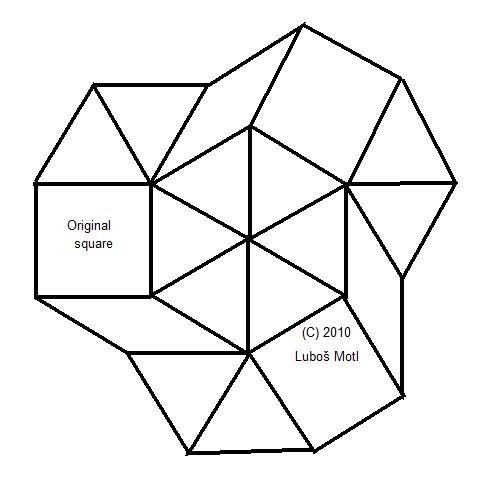


An example of a solution attempt that doesn't work. Your humble correspondent drew many of them! :-)

It seems pretty clear to me that no solution of the kind that is describe in the previous big paragraph can exist. You must make the structure solid by thinking outside the box a little bit. :-) If it helps you, here is a Mathematica 7 code that allowed me to find my more nontrivial solution once I understood the broader concept that is actually promising:
finds = {{0, 0, 0, 0, 0, 0, 0}};

(* next, separated line with input *)
Dynamic[{a, b, lenVsq, c, d, e, f}]
Dynamic[MatrixForm[finds]]

(* next, separated line with input *)
For[a = 1, a <= 7, a++,
For[b = -7, b <= 7, b++,

v = {a, 0} + b*{1/2, Sqrt[3]/2};
lenVsq = v[[1]]*v[[1]] + v[[2]]*v[[2]];

For[c = -5, c <= 5, c++,
For[d = -5, d <= 5, d++,
For[e = -5, e <= 5, e++,
For[f = -5, f <= 5, f++,

u = {d/2 + c, d*Sqrt[3]/2}
- {f*Sqrt[3]/2, f/2 + e};

lenUsq = u[[1]]*u[[1]] + u[[2]]*u[[2]];

finds =
If[(c*c + d*d)*(e*e + f*f) != 0 &&
Abs[lenUsq - lenVsq] < 0.00001,
finds~Join~{{a, b, lenVsq,
c, d, e, f}}, finds];

]
]
]
]
]
]

I guess that if you're not told the main idea, chances are that even the code above will be useless for you. Their "solution 43" as well as my "solution 29/31" have already been posted to the web but I won't give you coordinates before some of you try to solve it - and perhaps find an even more economical solution?

Bonus: a no-go theorem

I am sure that I was not the only one who got stuck for some time with tests of pictures like this one:


Well, JollyJoker is another victim because the picture above was offered by him.

Note that there is a whole class of pictures where all the linkages are either vertical, or horizontal, or have another azimuthal angle that is a multiple of 30 degrees. Correspondingly, all internal angles of all faces are multiples of 30 degrees as well - 30, 60, 90, 120, or 150 degrees.

With some help from TRF, it's straightforward to prove that no picture of this kind can be rigid.

First, use (0,0), (1,0), (0,1), (1,1) for the vertices of the square. If all edges have one of the allowed azimuthal angles mentioned above - 0, 30, 60, 90, 120, or 150 degrees (or the opposite-direction edges whose azimuthal angle differs by 180 degrees), then all vertices or hinges indirectly connected to the square have coordinates that are integer linear combinations of the following four vectors:
t = (1, 0)
u = (1/2, sqrt(3)/2)
v = (0, 1)
w = (sqrt(3)/2, -1/2)
Note that the nontrivial numbers are, up to the last sign, sines and cosines of 30 or 60 degrees. However, if you have a collection of points whose coordinates are
at + bu + cv + dw,
a, b, c, d are integers,
then you can see that both coordinates of the points are integer combinations of 1/2 and sqrt(3)/2. However, you may deform the picture by preserving vectors t,u and rotating v,w into v',w':
v' = (sin(phi), cos(phi))
w' = (sin(120°+phi), cos(120°+phi))

point' = at + bu + cv' + dw',
a, b, c, d are integers.
All edges whose length was equal to 1 in the old diagram - composed of points with coordinates point - have to have the length 1 in the new diagram composed of points with coordinates point'. That's because
t, u, t-u; -t, -u, -t+u;
v, w, v+w; -v, -w, -v-w
are the only integer combinations of vectors t,u,v,w whose length is (or was) exactly equal to one (see below). However, if you replace v,w by v',w' in the expressions above, it's still true that all the vectors will have length equal to one. That proves that the diagram may be tilted.

To show my lemma, recall that the general linear combinations of the vectors t,u,v,w may be written as
{ (A+B sqrt(3))/2, (C+D sqrt(3))/2 }
Four times the squared length of this vector should be equal to 4 but it is
+ A2 + 3B2 +
+ C2 + 3D2 +
2 sqrt(3) (AB+CD)
where A,B,C,D are integers. This can only be equal to 4 if (AB+CD) vanishes - it's the coefficient of the square root of three, an irrational number that can't cancel against others because of the integrality of the coefficients. Moreover, the four positive terms on the first two lines have to add up to four.

It may only happen if this number four arises as 4+0+0+0 or 0+0+4+0 or 1+0+0+3 or 0+3+1+0 - all higher numbers are easily seen to exceed 4. Moreover, 1+3+0+0 and 0+0+1+3 are also forbidden because AB+CD would be nonzero (plus minus three). That proves that there are only 6 possible vectors and their 6 opposite vectors whose length is equal to one. In terms of the old basis, they were written as
t, u, t-u; -t, -u, -t+u;
v, w, v+w; -v, -w, -v-w
You see that the combinations of t,u are decoupled from the combinations of v,w, so you may rotate v,w separately from t,u (that you may keep fixed, for example), and it won't break any of the linkages because all linkages that existed will continue to have length equal to one.

This no-go theorem is an example of the fact that you may get stuck in drawing seemingly pretty pictures and you may hope that if you combine the flowers in a cleverer way than an hour ago, you will succeed. However, it can be shown that the whole infinite class of such pictures is ruled out.

The same thing holds in many other contexts. In particular, all people working on discrete theories of spacetime - or any quantum theory of gravity that is not equivalent to string theory - may spend lots of time (it's decades or centuries rather than hours in this case) by fabricating more convoluted models.

But it can be seen that there are no consistent non-stringy theories of quantum gravity. The latter statement and its proof are more complex than the example above - and the proof arguably demands a lot of knowledge from the readers - but the statement is equally true as the no-go theorem for solutions to the linkage problem whose angles are multiples of 30°.

You need to add a new player - internal angles that are not multiples of 30 degrees, in this case - to have a chance to find a solution. Then you enter a broader, different set of candidates - the counterpart of the string theory landscape - and in this set of candidates, which encourages you to study different issues than in the wrong class and to generalize them in different ways than before, you may actually construct correct and/or minimal solutions to your problem.


Spoilers: best solutions with 31 extra edges

The best solution available at this moment was found by your humble correspondenent by refining the Pythagorean idea. The Pythagorean solution was independently found by Phil Gibbs, Bill K, and Honza U. who was the first successful TRF reader to solve the challenge:
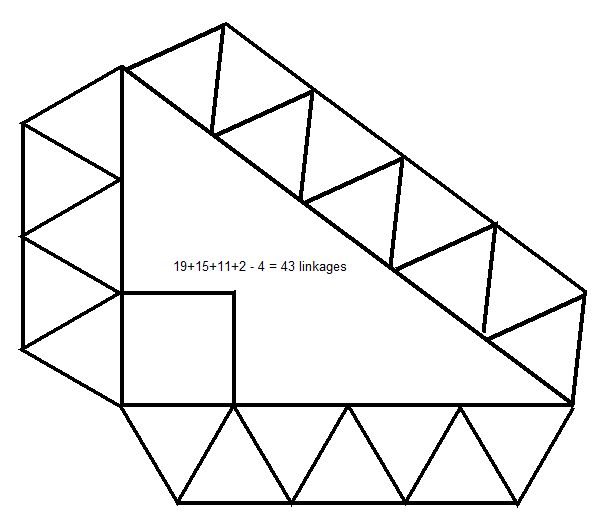


The solution uses the Pythagorean identity 3^2+4^2=5^2. The three "rigid bridge elements" contain 19, 15, 11 linkages, respectively, and 19+15+11+2-4 = 43 new linkages. The number doesn't change if you allow self-intersections (a point that was misinterpreted by Honza).

Mr/Ms Imho cannot be counted as a successful solver because he or she thought that you can erase the whole bridge elements and preserve just the 3+4+5 thin linkages surrounding the large 3-4-5 Pythagorean triangle (which would mean 12-2=10 extra linkages). Well, indeed, such a construction wouldn't be rigid at all and I hope that Mr/Ms Imho is not a professional architect. :-)

However, using the Mathematica code above, I found a more efficient solution that only uses 31 extra line segments:


or, if you allow frictionless intersections of the line segments, 29 extra linkages:


It is similar to the 3-4-5 Pythagorean triangle except that the catheti are not 3 and 4 but rather 2 and 3. You may complain that the hypotenuse is not an integer. Indeed, it's not: its length is sqrt(2^2+3^2) = sqrt(13).

However, one can create a rigid line segment of length sqrt(13) using the equilateral triangular truss, too. Draw a triangular truss that includes horizontal lines and the point (0,0). Make three steps to the East (right): the coordinate of the final point will be (3,0).

Now, make a step to the (almost) Northeast. You will add (1/2, sqrt(3)/2) to the coordinates of your point so the final point will be
(3.5, sqrt(3)/2)
The squared length of this vector - the distance between the two points of the triangular truss - equals
3.52 + 3/4 = 12.25 + 0.75 = 13
just like previously. So three pieces of the triangular bridge construction may be connected just like in the case of the 3-4-5 Pythagorean triangle and the right angle of the square is ensured in this way.

The Mathematica program above, which has only searched through a set of sufficiently "small" solutions, has also found a solution with the hypotenuse equal to sqrt(39). In that solution, one has to use both directions of the triangular trusses on all three sides of the big triangle.


Exhaustive search: a proof of minimality

It's actually not hard to find the 29/31 solution above in a controlled, exhaustive search for economical solutions. Earlier in this text, I showed that there must exist internal angles that are not multiples of 30 degrees. Obviously, there must exist at least two such hinges where the internal angles not divisible by 30 degrees exist.

At least two such hinges are indirectly connected to the square by some linkages. Look at these two hinges. Of course, in the minimum setup, there will be exactly two such linkages.

The assumption in the previous sentence was proved to be wrong. The current most economical solution known to me - at the top of the article - depends on four hinges whose internal angles differ from multiples of 30 degrees. This fact invalidates the rest of the proof but it may still be interesting for you to read it.

To fix the angles of the square, the distance between these two linkages must be protected by an additional network of linkages - which will become the "hypertenuse" in the Pythagorean-based solutions. It's almost guaranteed that the minimal structure that preserves the distance is made out of a triangular truss.

Now, you may enumerate all the squared distances you may obtain from a triangular network. If you classify them by the number of "Northeast" steps, the allowed squared distances are:
0 NE steps: 0, 1, 4, 9, 16, 25, ...
1 NE step: 1, 3, 7, 13, 21, 31, ...
2 NE steps: 3, 4, 7, 12, 19, 28, ...
3 NE steps: 7, 9, 13, 19, 27, ...
4 NE steps: 12, 13, 16, 21, 28, ...

union: 0, 1, 3, 4, 7, 9, 12, 13, 16, ...
The last line will be referred to as the white list.

Note that all of the squared lengths are integers. These are the allowed squared lengths of the "hypertenuse" block that preserves the distance between the two hinges. Now, the two hinges are connected to the square, so their coordinates have to differ by an integer combination of the vectors t,u,v,w mentioned previously.

Let's redo an exercise we did in a different basis. A general integral combination of the vectors t,u,v,w - the vector difference between the two hinges, as calculated from the block containing the square
At + Bu + Cv + Dw
has the squared length equal to
A2 + B2 + C2 + D2 +
+ AB - CD + sqrt(3) (AD + BC)
There are no AC and BD terms because the pairs t,v and u,w are orthogonal: even in the upper part of the text, I have switched the sign of "1/2" in w to "-1/2", apologies to old readers. ;-)

Now, because the squared distances that can be supported by the "hypertenuse" blocks are integers, it follows that AD+BC has to vanish. Consequently, it can't be true that exactly three of the numbers A,B,C,D are nonzero: either 4 or 2 (or fewer) are nonzero. If 2 (or fewer) numbers among A,B,C,D are nonzero, we have either B=D=0 or A=C=0, which returns us to the Pythagorean numerology and 3-4-5 is the smallest solution (optimization of the 3-4-5 triangle may be discussed separately) , or A=B=0 or C=D=0 which are not allowed because the construction would only be attached to one of the sides of the square.

If all A,B,C,D are nonzero, which is the only room for solutions that may differ from the Pythagorean 3-4-5 concept, we have to check the combinations
A,B,C,D = K,L,K,-L
A,B,C,D = K,K,L,-L
K,L = 1,1 or 1,2 or 2,2 or 2,3
and their equivalents with sign flips and permutations that don't change the essential geometry (and the new angles at the special hinges). The apperance of K,L = 3,3 or more or K,L = 2,4 or more would already produce the total squared length above 31. We must also check
A,B,C,D = 1,2,2,-4.
However, it produces the squared length of 1+4+4+16+2+8 = 35 or 1+4+4+16-2-8 = 15 (for -1,2,2,4) which are not on the "white list" and are getting too high, anyway. Similar small values of A,B,C,D that are not pairwise equal may be seen to produce too big a squared length, or a squared length that is not in the allowed list. For example, for A,B,C,D=1,2,3,-6, one gets AD+BC=0. However, the squared length is 1+4+9+36+-(2+18)=50+-20 which is 30 or 70, too large.

That's why we have reduced the unknown yet promising solutions to the cases when all A,B,C,D are nonzero and expressed in terms of K,L as above. In the two inequivalent cases that make AD+BC vanish, namely K,L,K,-L and K,K,L,-L, the squared length of the vector (the sum of squares of A,B,C,D plus AB-CD) is equal to 2K^2+2L^2+-2KL or (3K^2+3K^2 or K^2+L^2).

The result must belong to the allowed list of squared lengths, 0, 1, 3, 4, 7, 9, 12, 13, 16, ... Clearly, the length 1 would only produce constructions with angles divisible by 30 degrees again which is no good, as proved at the beginning. Let's continue with the white list.

What about the squared length equal to 3, 7, 9, or 12?

The odd numbers can't be obtained as 2K^2+2L^2+-2KL because the latter is even. They can be written as K^2+L^2 or 3(K^2+L^2) but only if one of K,L vanishes... We want both K,L nonzero, as mentioned previously (because the construction would only be attached to one side of the square).

The smallest number of the form K^2+L^2 for positive integers K,L that is on the white list is 13 for K,L=2,3 or 3,2: numbers 2,5,8 are not on the white list. And 18 = 3^2+3^2 that would be just a little bit bigger is not on the white list, either.

The template 3(K^2+L^2) is clearly even less useful to create small solutions. The smallest allowed values of this tripled sum for positive integers K,L, namely 6,15,24..., are not on the white list, either. So far, K^2+L^2=9+4=13 is the only nontrivial small solution we found.

Finally, we must deal with the template 2(K^2+L^2+-KL); of course, the negative sign is better to produce smaller results. This can only match the even numbers on the white list, namely 4,12,16..., because it is even. K^2+L^2+-KL would have to be equal to 2,6,8... However, 2,6,8 can't be written in this form: 2,6 are equal to 2 modulo 4, but K^2+L^2+-KL can't be 2 mod 4. And 8 is also impossible for similar reasons.

So the only new small solution we found was one based on the hinges whose distance is sqrt(13).

Top intersecting solution

The assumption of just 2 vertices (hinges) that are not combinations of t,u,v,w is severely violated in the state-of-the-art best solutions. At the top, there is bbzippo's non-intersecting solution with 23 extra linkages.

Frictionless intersecting solutions can go down to incredible 15 extra linkages. This one is an example - a modified JollyJoker's structure:


Note that the original square with the pink vertices is rotated by 45 degrees. There are 3 additional - blue - vertices in the picture. Their 6 coordinates are constrained by 7 conditions on the length; this overdetermined system of conditions (by one) is just the right amount to fix the angle of the square with pink vertices.

The 7 distances that are fixed include the 3 vertical length-one distances from the adjacent pink vertices of the square; 2 length-one distances of the central light blue new point from the two dark blue new points on the sides; and 2 length-sqrt(3) distances of the upper blue points from the most distant pink vertices on the opposite side - that are realized by the di-triangle rhombuses.

This new solution brings you into an entirely new class of possibilities. Just add N vertices to the plane - outside the integer combinations of t,u,v,w - such that 2N+1 distances between these vertices (either between pairs of them, or between the vertices and arbitrary points in the "lattice" of integer combinations of t,u,v,w) belong to the white list (i.e. can be realized by inserting parts of triangular trusses).

Such a new template looks very general and it would be very time-consuming to look for all solutions, even pretty small ones, but I can still argue that even this general class actually doesn't exhaust all the possibilities. One could also "add the angles" etc.