
Showing posts with label Images. Show all posts
Showing posts with label Images. Show all posts
Saturday, April 23, 2011
The high cost of healthcare in America (infographic)
The high cost of healthcare in America (infographic) - click on the image to see the larger-size file. The site hosting the infographic, MedicalBillingandCoding.org, is one of the URL-grabbing portals that redirects to other sites, so be careful what you click there once you go beyond the image.

Thursday, March 17, 2011
Microsoft software to "replace" radiologists - recognizes organs and structures in medical images
Microsoft Research, Mar 8, 2011: InnerEye focuses on the analysis of patient scans using machine learning techniques for automatic detection and segmentation of healthy anatomy as well as anomalies:
Antonio Criminisi is the the researcher shown in the video above.
High-Performance Cancer Screening: See how a high--performance, 3-D rendering engine can be transformed into a real-world, life-saving medical application:
References:
Antonio Criminisi is the the researcher shown in the video above.
The InnerEye research project focuses on the automatic analysis of patients' scans by using machine learning techniques for:
- Automatic detection and segmentation of healthy anatomy, as well as anomalies
- Semantic navigation and visualization
Microsoft Research methods aim to combine medical expertise and modern machine learning theory in the design of tools for computer-aided diagnosis, personalized medicine, and natural user interfaces for surgical intervention.
The InnerEye project has a host of famous collaborators, including Johns Hopkins Medical Institute, The University of Oxford, Cornell Medical School, Massachusetts General Hospital, the University of Washington, Kings College London, and Cambridge University Hospitals.
High-Performance Cancer Screening: See how a high--performance, 3-D rendering engine can be transformed into a real-world, life-saving medical application:
References:
Comments from Twitter:
@hrana (Hisham Rana, MD): No thanks. RT @DrVes: Microsoft software to "replace" radiologists - recognizes organs and structures in medical images http://goo.gl/HwNNx
@doctorwhitecoat (Vamsi Balakrishnan): Definitely not a replacement... but cool tool in development.
@DrVes: Well, of course it's not a replacement... :) Just as "Watson" supercomputer won't replace PCPs/specialists...
@doctorwhitecoat (Vamsi Balakrishnan): Watson can't replace 3rd year Med students either; it can't do scutwork...:)
@ILoveOrthopedix (Orthopaedic Resident): MS Radiology! very interesting - the ECG machines recognise patterns & give diagnoses, but all the doctors make their own diagnosis.
@drcrosby (Bradley Dick): Reminiscent of Robin Cook's "Brain"?! (http://en.wikipedia.org/wiki/Brain_(novel))
Tuesday, October 19, 2010
Stereotypes in medical photographs
From BMJ:
If you search "medicine" on Google Images, you get a hundred million photographs.
The most common image is a stethoscope. The next is a bottle of pills (or, sometimes, red and black capsules). The next is a surgeon, masked and gowned, slicing skin with a scalpel.
Try "patient" and you will find lots of people in stripy pyjamas, lying obediently in bed, often with a spotty rash or a leg strung up in an orthopaedic hoist.
New images are needed to break the century-old stereotypes in medical photographs.
References:
New images needed: stereotypes in medical photographs. BMJ 2010;340:c1524.
Saturday, July 31, 2010
Not what it seems: Desert Island
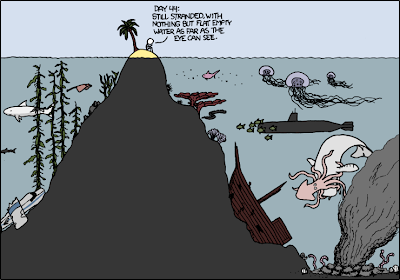
Not what it seems: Desert Island (click to enlarge the image). The obvious is sometimes hidden - this often applies to clinical evaluation of patients and research.
References:
http://xkcd.com/731
Thursday, July 8, 2010


Sunday, August 9, 2009
Impressive: SprintCam v3 showreel, made during a recent rugby competition in the Stade de France, Paris
I-Movix SprintCam v3 NAB 2009 showreel from David Coiffier on Vimeo. Go to Vimeo f0r the HD version of the clip.
Link via Dr. Shock who used to play rugby when he was younger.
Subscribe to:
Posts (Atom)


