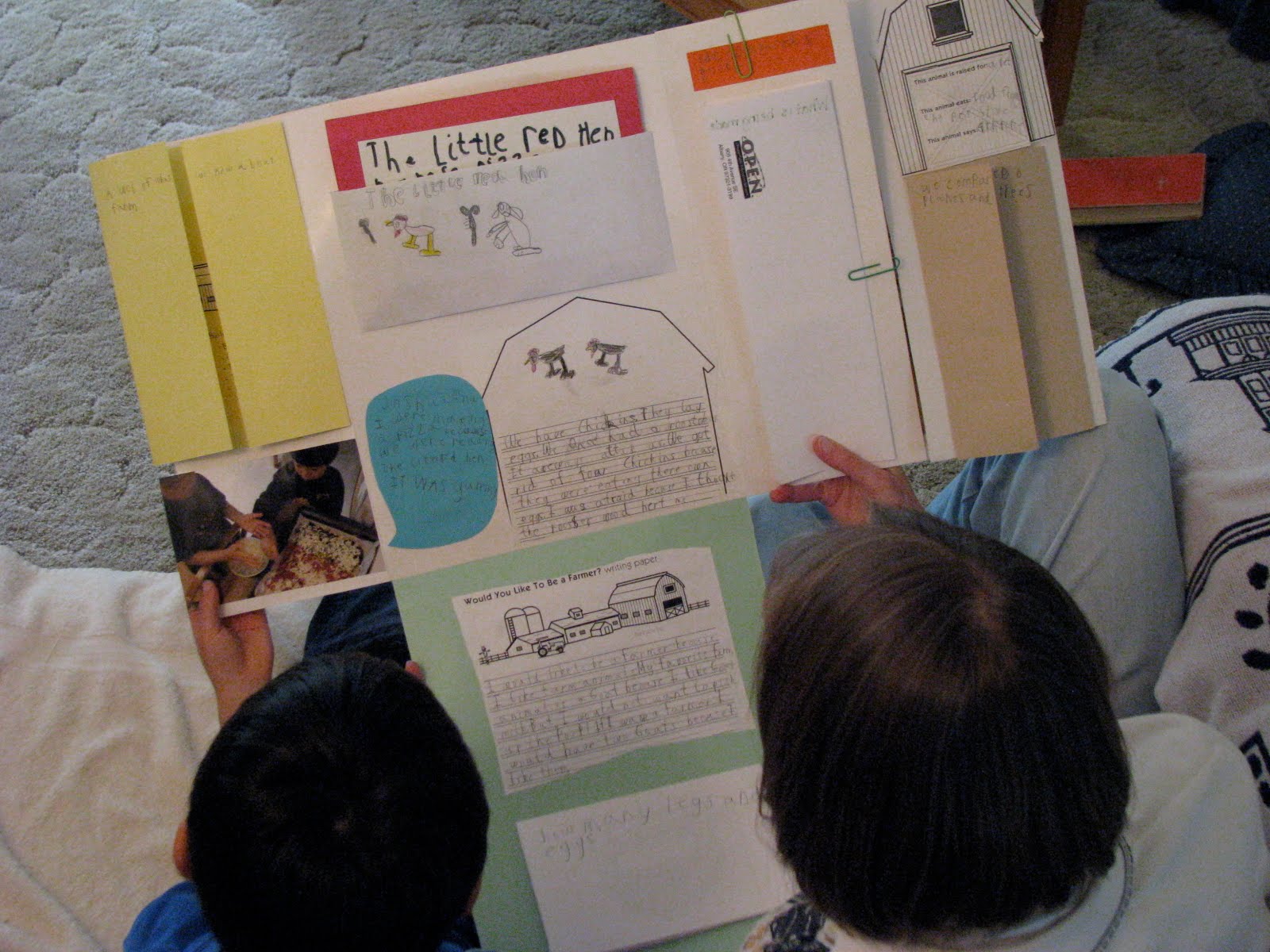
We wrapped up our farm unit today by making a Portfolder, characterized by the following:
made from poster board
show student thinking from beginning (What do I know about my subject? What do I want to know about my subject?) to end (What have I learned?) of any given unit of study
filled with students' comments and reflections about what they've learned
photos show children actively learning
include book/materials list of resources used during the unit
cover reflects original student artwork
charts, graphs, timelines and other graphic organizers are kid-generated
layout is determined by the child
Today, my student did the layout and paste-up for his farm portfolder. [Cover photo, left.] Since the portfolder is intended to show the learning process, he wrote in little dialogue bubbles, describing various activities and lessons from the unit. He also took time to reflect on learning: what was the most fun, what proved to be the greatest challenge, etc. This became an interesting point of conversation when the assignment that was the most fun was also the part that gave him the biggest challenge. (Little Red Hen book) It was great to be able to note that challenges can be quite fun!
When a Portfolder is finished, it's time to celebrate and share learning with others. Tonight he shared the contents with Dad and siblings. Tomorrow with grandparents. And, perhaps a celebratory lunch?
Here are several views of the finished Portfolder. It's impossible to show the fronts/backs of the numerous flaps, but you'll get the general idea.
Open to first section:
Open to second section:
Closed, back cover: The beauty of a Portfolder? He'll return to look at his work again and again, reviewing and sharing with others in the process.
As part of our farm unit, Little Student, age 7, has been working on his own version of The Little Red Hen. After we read several versions of the story, he made a story map and then dictated his version to me as I typed. Although he often (physically) writes, in this case I wanted him to be able to concentrate on text without worrying about manually putting the words on paper. I think he produced a more fleshed-out story as a result. This is truly his work.
He chose to make a pop-up book; they are tremendously easy to make with great results. He is excited to "publish" his work here and eagerly awaits comments from his readers. ;)
Once upon a time there lived a hen, a rat, a dog, and a mouse. The hen wanted to make a pizza. The hen asked the rat, dog, and mouse to help her get the ingredients.
Who will help me go get the dough and the toppings?”
“I will,” said the dog.
“I will,” said the rat.
“I will,” said the mouse.
So they went to the store and got the dough and the toppings. The rat and the mouse argued over who would hold the cheese.
When they got home the hen asked, “Who will help me make the pizza?”
“I will,” said the dog.
“I will,” said the rat.
“I will,” said the mouse.
The dog put on the pepperoni. He took a nibble and stuck out his tongue. The rat and the mouse put on cheese. They took a little bite. When they were done, they made a disgusting face.
“Who will help me bake the pizza?”said the hen.
“I will,” said the dog.
“I will,” said the rat.
“I will,” said the mouse.
So they baked the pizza.
When the pizza was ready, the hen asked the dog, rat, and mouse to help her eat the pizza. “Will you help me eat the pizza?”
“I won’t,” said the dog.
“I won’t,” said the rat.
“I won’t,” said the mouse.
So the hen ate it by herself. The dog chewed on a bone. The rat and the mouse found seeds and ate them. The hen made a disgusting face.
Our little farm is growing. Today, little student bought horses to add to the farm, again investigating area with land squares and perimeter with fence squares. He also updated his farm map (as seen in the photo.) Just a few crops left to go...
Meanwhile, we're seeing some interesting creatures on our own "farm." Can you spot him?
We're continuing to add animals to our farm. Today, with the addition of chickens, we're doing a side trip with the Little Red Hen.
In the last few decades, the children's book market has been inundated with "fractured" versions of traditional folktales and fairytales. When examined together, this provides an incredible opportunity for doing some comparison/contrast. We collected several versions of The Little Red Hen. Possibilities include:
After reading the books, we talked about the similarities and differences. My student noticed a difference in the setting, characters, item being made/problem and the conclusion. We made a chart to directly compare the three books.
And I couldn't say "no" to a request to make a pizza together after reading The Little Red Hen Makes a Pizza. Who will help me make the pizza? "I will!" say two little students.
After pizza lunch we printed a story map to plan out my student's own version of The Little Red Hen which he'll begin writing tomorrow.
The boys watched themselves on video this morning. Over and over and over. Then they wanted to perform. Again and again and again. No shortage on activity for a rainy morning around here. ;)
We're continuing with lessons in My Little Farm, buying sheep and goats to add to the pasture. My student calculated how much the animals, land, and fencing would cost him. He's beginning to explore perimeter as he figures how much fencing he needs for each animal pasture. The lesson comes with a fact sheet of cards you cut out naming characteristics of sheep and goats. He sorted them, pleased that he knew which facts go with which animals; we decided that he will quiz Daddy on them later tonight.
Tomorrow we'll head to the library to pick up a few more books on farm life. Which brings to mind a few favorite books with animals in starring roles...
My 4-year-old student is new to English. We've read a lot to him since he came home about 10 months ago. He loves most books. But he has two favorite series worth mentioning: Elephant/Piggie books by Mo Willems and the boy/dog/frog books by Mercer Mayer.
The Elephant/Piggie books (such as I Am Going, which the 4-year-old now recites) are easy readers with hilarious text/photos. It's not often I find myself laughing aloud at an early reader, but I do with these!
The boy/dog/frog books (such as One Frog Too Many) are wordless picture books with captivating story lines. Wordless picture books help children to become readers as they first understand the concept of a story (front to back, beginning/middle/end) and then build vocabulary and comprehension as they tell the story in their own words. The readers in my family enjoy these books just as much as the non-readers. Wordless picture books can also be used with older kids as a basis for creative writing.
In conjunction with our farm unit we decided to do a puppet show of The Three Billy Goats Gruff. My student drew one goat which we photocopied and reduced by 75% and 50% to make the two smaller goats. He also drew a troll. Little helper, just turned 4-years-old and only 10 months into learning English, assisted in the performance, repeatedly begging, "Do it again! Do it again!"
"Speaking" of which...
When I first started homeschooling, I had a few concerns. "Socialization" was near the top of the list. (I soon came to realize this was a joke. We socialized so much the first year that we hardly had time left for school. We cut waaaayyyy back and eventually came to a happy medium.) Related to socialization was the idea of public speaking/presentations. Since my children were not in large classes, I felt that speaking opportunities must be deliberate, frequent, and purposeful. At young ages we acted out stories or made puppet shows, performing for anyone who would listen...usually Daddy, siblings, and grandparents. We joined book clubs and co-ops where students regularly presented. Later came Lego Robotics and Shakespeare productions. It's paid off. My daughter, now a freshman in a large public high school, has excelled in speech competitions. Last year, two of my kids competed in Lego Robotics on a national level, where their performance depended heavily on their speaking/presenting skills.
All that to say that this is where they began...
The older kids did their own version of The Three Billy Goats Gruff when they were young. We all start somewhere. :)
When kids are young, I start by repeatedly reading a story. When they have the story line down, I like to do the puppet show with them, modeling how to use the puppets in the context of the story. As soon as they're ready to take over, I happily bow out and let them continue without me. Today I heard many, many different versions of the story as they considered what they wanted to say. (A lot of whispering went on "backstage.") It's fascinating to watch them internalize the story, getting louder and more clear as they become more comfortable with the performance aspect. The request to "do it again, do it again!!" didn't stop today.
Today we reviewed coordinates and learned map skills as we mapped our farms**.
We also enjoyed reading The Three Billy Goats Gruff and drawing a picture to accompany the field trip report. The picture is as cute as the real thing! :)
P.S. When my older kids did this unit, they drew figures to mount on sticks for a Three Billy Goats Gruff puppet show. I was just thinking that I could photocopy my student's drawing from today and reduce it to make three sizes of figures for another puppet show. (He's not ready to draw all the figures himself.)
Day 4 of My Little Farm is taking several days because we're having so much fun going down rabbit trails...or should I say "goat trails?" We first read about goats and documented what we'd learned in a chart. After learning that a friend's goat gave birth to triplets, today we set off on a mini field trip to see the babies, less than a week old. We learned some things we didn't know...like those little babies are very LOUD!
We discussed our visit and began writing. My industrious little pupil decided to add a challenge...to attempt to add one of his new vocabulary words to his paper. He's been reading Charlotte's Web and recording each new word he notices, along with a definition and a brief sentence. Each night at the dinner table he captivates his older siblings by using words that they don't always know. (He's rather pleased about this!) So on his goat paragraph he wrote, "We went to Mary's house to look at goats. We went to see the triplet goat babies. The baby goats BAAAD unremitting for five seconds. They were running and jumping 30 minutes after they were born. The goats were cute." Any guesses as to what his new vocabulary word is? [Smile.] We'll map out our farm tomorrow.
We just started a new unit based on My Little Farm (Bridges Breakout).
Description: "Life on a small family farm provides the context for exploring place value, money, area and perimeter, mapping, and computation. In this 4-week unit, students create a paper model of a farm and learn about farm life and farm animals."
Yesterday we created a web of things we might find on a farm. "Farm bucks" were distributed and cut. Farm mapping began this morning; you can see the house/land and road...paid in cash today! Each day we'll be continuing to add to our farm layout.
We are creating a portfolder of our work, adding to it as we go... I'm using Draw Write Now, Book 1: On the Farm-Kids and Critters-Storybook Characters for assistance with drawing farm critters. The drawings shown on the portfolder cover were independently done by a 7yo, following directions from the book. New vocabulary words, found in Charlotte's Web, are recorded on notecards with definitions and sentences. It's sticking! The word "glutton" was giggled over at dinner last night. :)
7yo student quote: "It's kinda like Farmtown on Facebook." (BTW, I do NOT play Farmtown!)